


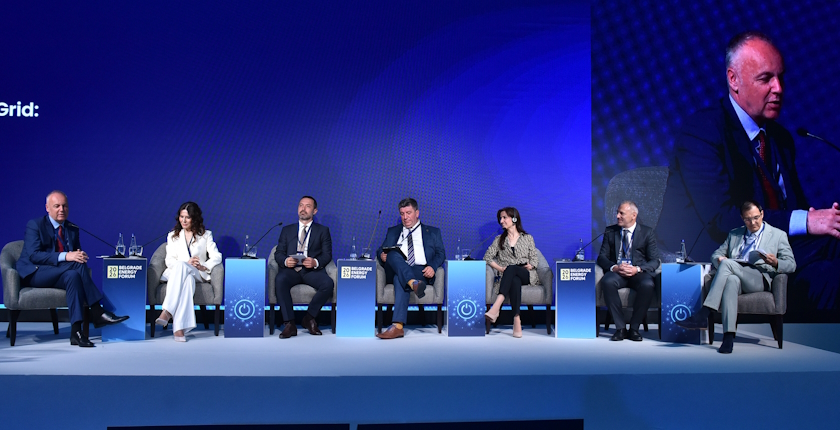
The green transition is no longer just about expanding renewable energy capacity, but increasingly about ensuring the stability and resilience of power systems, according to a panel on building a robust transmission grid, held as part of Belgrade Energy Forum 2026. Representatives of transmission system operators (TSOs) from across the region warned that without major investments in grids, digitalization, and energy storage, it will not be possible to maintain security of supply in an era of rapid decarbonization.
The panel discussion, titled Establishing a Robust Transmission Grid: The Essential Role of Balkan TSOs in the Green Transition, was held as part Belgrade Energy Forum – BEF 2026. It was moderated by Aleksandar Mijušković, Chairman of the Board of Directors of Montenegrin TSO Crnogorski elektroprenosni sistem (CGES).

Aleksandar Mijušković, Chairman of the Board of Directors, CGES
Serbia’s TSO, Elektromreža Srbije (EMS), is prepared to connect an expected 12 gigawatts of renewable energy capacity to the transmission grid over the next six years, said EMS General Manager Jelena Matejić.
She recalled that Serbia’s power transmission system has eight interconnection borders and as many as 20 interconnection transmission lines, giving the country an important role in regional energy integration. “This allows us incredible flexibility and potential for further development and integration – both market integration and the interconnection of transmission systems across this part of Europe,” said Jelena Matejić.
Matejić: Serbia’s transmission grid will integrate 12 GW of renewables in the next six years
EMS has invested EUR 620 million over the past 10 years alone, mainly in the transmission system, but also in the development of digital and innovative technologies for grid management and maintenance, she stated. “In the past three years, the investment momentum has been such that it accounts for more than 45% of the total investment in the 10-year cycle. Last year, we recorded a remarkable, historic figure of EUR 135 million in realized investments, achieving 95% of the plan,” she said.
By 2028, an additional EUR 740 million in investments is planned, while total investments by 2030 are expected to reach EUR 1 billion, according to her.
Speaking about the green transition, she said that EMS’ strategic plans involve the implementation of four pan-European projects, the largest part of which is expected to be completed by 2030.

Jelena Matejić, General Manager, Elektromreža Srbije (EMS)
She also noted that it is often overlooked that EMS’ primary task is to maintain the security and stability of electricity supply for consumers and industry, an issue brought into focus by the two ongoing wars.
Belgrade Energy Forum is an annual event organized by Southeast Europe’s leading energy news portal, Balkan Green Energy News.
Asanović: System stability must not take a back seat
Ivan Asanović, Executive Director of CGES, also underscored the seriousness of the challenge, noting that the regionwide blackout in June 2024 was a warning that system stability must no longer take a back seat. “We witnessed a breakdown of the Balkan transmission system, when Montenegro, parts of Albania, Croatia, and Bosnia and Herzegovina were left without power. It served as a warning,” he said, adding that security analyses show system stability is at risk.
He warned that large volumes of transit flows pass through the region’s small transmission systems, seriously threatening grid stability. The solution, according to him, lies in coordinated capacity calculation.

Ivan Asanović, Executive Director, CGES
CGES has recently put into trial operation a shunt reactor for voltage regulation in Montenegro’s southern region, he said, adding that one section of the Trans-Balkan Electricity Corridor – specifically the transmission line between Lastva and Pljevlja – is nearing completion.
Montenegro currently has grid connection requests for projects totaling 7 GW
Montenegro currently has grid connection requests for projects with a total capacity of around 7 GW, while its current generation capacity is only about 1 GW, according to Asanović. Requests for around 4.5 GW have been processed, with contracts signed for nearly 3 GW, he said.
He said that CGES typically implements projects worth EUR 28 million from a EUR 40 million investment plan. The company faces challenges, including property issues and complex tendering procedures, but is striving to ensure that grid development does not hinder the green transition.
Paunoski: Solar expansion poses a challenge to grid stability
Representatives of TSOs from the region also highlighted the rapid growth of solar power plants, which is creating new challenges for grid stability.
Aleksandar Paunoski, Deputy CEO of North Macedonia’s MEPSO, said that the share of renewable energy sources in the country’s overall installed capacity increased from 38% in 2021 to as much as 58% in 2025. Solar power plants today account for more than 20% of domestic generation, which is good news for decarbonization but creates challenges for the power system, he said.
Solar power plants today account for over 20% of North Macedonia’s overall power output
In addition, a large number of solar power plants connected to the distribution grid are not sufficiently visible to TSOs, which leads to significant deviations in system balancing, Paunoski explained.

Aleksandar Paunoski, Deputy CEO, MEPSO
Charpantidou: Renewables integration must go hand in hand with system flexibility and regional cooperation
Eleni Charpantidou, Investment & Platform Director at Greece-based Terna Energy, owned by Abu Dhabi Future Energy Co. (Masdar), stressed that the Western Balkans have an enormous advantage thanks to hydropower and the potential for energy storage.
She emphasized that the integration of renewable energy sources must go hand in hand with system flexibility and regional cooperation.
Charpantidou also recalled that Masdar is investing in wind farms and solar parks in Serbia, and that it recently signed an agreement in Montenegro to develop renewable energy projects with a total capacity of up to two gigawatts.

Eleni Charpantidou, Investment & Platform Director, Terna Energy
Vukojević: Stricter criteria, harmonized regulation and new approaches for grid connection of generation projects
Managing Director of GMS Consult, Goran Vukojević, warned that the region is facing a large number of grid connection requests for new energy projects, while significant differences remain in the seriousness and readiness of investors.
“It is important for transmission system operators to introduce stricter criteria in order to clearly distinguish serious investors from those without realistic implementation plans,” Vukojević said.
As a positive example, he highlighted the model implemented by Elektromreža Srbije (EMS), which requires bank guarantees and balancing responsibility for projects seeking grid connection. According to him, this approach effectively filters serious projects and prevents long-term blocking of grid capacity. Additional measures could include stricter project implementation deadlines.

Goran Vukojević, Managing Director, GMS Consult
Vukojević also stressed that the issue is not only on the investors’ side, but also in the lack of alignment between national legislation and administrative procedures, which often results in delays lasting several months.
He pointed to positive examples from the United Kingdom and the United Arab Emirates, where transmission system operators organize auctions for carefully selected grid connection points for new generation facilities, in line with system development and security needs. In his view, such a model could also be successfully applied across the region.
Austria accelerates its energy transition: focus on flexibility, digitalization, and grid development
Milan Vukasović of Austria’s TSO, Austrian Power Grid, said that even developed European grids can no longer keep pace with the demand for connecting new capacities without serious optimization of existing infrastructure and substantial investment.
Late last year, Austria adopted a new regulatory framework in the energy sector, defining the rules for power system development more clearly, with a key focus on grid flexibility, digitalization, and the protection of the most vulnerable consumers. The aim is to maximize the efficiency of existing infrastructure before proceeding with costly investments in new grid capacity, Vukasović said.
He recalled that Austria, together with Switzerland, now represents one of the most important energy transit hubs in Central Europe, linking the markets of Germany, Italy, France, and the Balkans. This position puts Austria’s grid under significant pressure from cross-border electricity flows, Vukasović explained.
“Two-thirds of the energy we import is transited further,” he said.
Austria’s grid development plan includes strengthening interconnections with neighboring countries
Vukasović stressed that the national economic loss could be estimated based on analyses of the German market, which is seen as a key benchmark due to the strong economic ties between the two countries. However, Austria’s macroeconomic costs are estimated at EUR 1 billion annually due to an insufficiently strong grid infrastructure and, among other factors, differences in electricity prices between the Austrian and German markets, as well as costs of congestion management and negative electricity prices, about one third of which originates from solar energy, he said.

Milan Vukasović, Austrian Power Grid
For that reason, Austria’s grid development plan focuses simultaneously on upgrading the internal network and strengthening cross-border interconnections with neighboring countries, Vukasović said. “The grid simply cannot keep up with connection requests. That is why optimizing existing infrastructure is beyond question,” he concluded.