





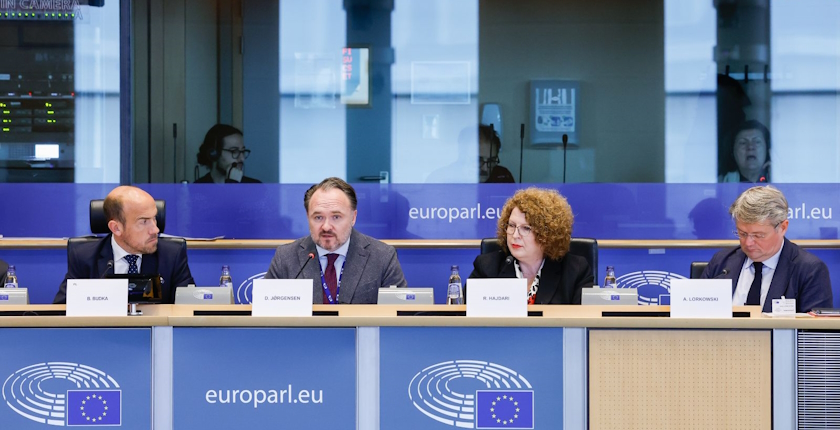
Photo: Energy Community


In focus at the Energy Community Parliamentary Plenum in Brussels was the mutual need to integrate energy markets to protect against price and security of supply shocks.
As Europe steps up efforts to prepare for a potential global energy crisis, parliamentarians from across the Energy Community, representing nine European Union–aspirant contracting parties in Southeastern and Eastern Europe, gathered in Brussels with members of the European Parliament. At the Energy Community Parliamentary Plenum, they were met by European Commissioner for Energy and Housing Dan Jørgensen and Energy Community Secretariat Director Artur Lorkowski, who called for stronger political backing of key reforms to integrate gas and electricity markets.
“The current crisis is a wake-up call. What was once a strategic necessity – the integration of our Energy Community – has now become an urgent imperative. We must stand united, sustain pressure on Russia, and accelerate our transition to the clean energy and electrification. Dependence on volatile regions and outdated energy systems is a risk we can no longer afford,” Jørgensen stated.
The Energy Community was founded on a simple truth, that cooperation in energy is the bedrock of peace, prosperity, and security, the commissioner asserted and stressed that it has never been more relevant than today.
“Now is the time to cross political and geographic divides and commit to creating a European energy system capable of withstanding geopolitical uncertainty. That is to form a united energy front through EU – Energy Community energy market integration, even ahead of Energy Community contracting parties’ accession to the EU,” Lorkowski said.
Same rulebook would set stage for deeper integration in gas sector
As concerns increase over future hikes in gas prices, the mutual application of gas network codes can position the Energy Community as an active and valuable partner within Europe’s gas neighbourhood, the international organization’s secretariat stressed.
Ensuring that all parties operate under the same rulebook would set the stage for deeper integration – reinforcing the region’s role as a key transit and storage hub, according to the update. Under the EU’s Fourth Gas Package, member states are expected to apply EU gas network codes from August at all borders, including with Energy Community contracting parties.
Lorkowski: Renewable energy is increasingly important for the creation of markets not dependent on foreign sources
In parallel, advancing electricity market integration with the EU would support the creation of larger, more competitive electricity markets, better equipped to absorb price volatility while sustaining investment in the energy transition, the secretariat pointed out.
Renewable energy is increasingly important for the creation of markets not dependent on foreign sources, Lorkowski underscored.
EU lawmakers can contribute to electricity market integration
By adopting EU-aligned electricity legislation of the Electricity Integration Package (EIP), the contracting parties can begin market coupling with the EU’s Single Intraday Coupling (SIDC) and Single Day-Ahead Coupling (SDAC), subject to compliance verification by both the Energy Community and the EU. Serbia, Moldova, and Montenegro have transposed the legislation.
The secretariat noted that EU lawmakers can help advance electricity market integration by supporting the European Commission’s proposal to amend the Carbon Border Adjustment Mechanism (CBAM). The proposal aims to better recognize renewable electricity imports from Energy Community contracting parties, helping avoid disincentives for clean energy trade and align carbon pricing.
Currently, renewable electricity exports are treated under CBAM in the same way as fossil-based electricity, discouraging imports of green electricity from the Energy Community region.

Be the first one to comment on this article.