







Photo: iStock


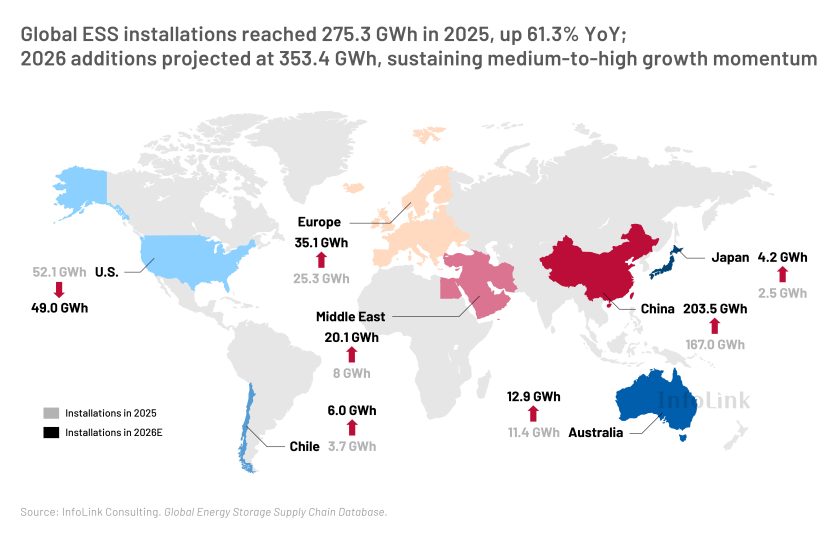
Energy storage installations totaled 275.3 GWh in 2025, a 61.3% year-on-year increase, according to the latest report by renewable energy market intelligence provider InfoLink Consulting. In 2026, the world is expected to add a further 353.4 GWh of energy storage capacity, driven by demand from AI data centers.
The report tracks battery storage deployments, cell shipments, and emerging demand from artificial intelligence (AI) data centers.
In 2025, the largest chunk of new battery storage capacity was recorded in China, 167 GWh. The country is projected to add a further 203.5 GWh this year, according to the report.
The United States added 52.1 GWh last year, with 49 GWh of new installations expected in 2026, while Europe installed 25.3 GWh in 2025 and is set to add 35.1 GWh this year. In Australia, 11.4 GWh of new installations were recorded in 2025, with 12.9 GWh forecast for 2026.
China is expected to install as much as 203.5 GWh of new battery capacity in 2026
In the Middle East, 8 GWh of new capacity was installed in 2025, while the forecast for 2026 is 20.1 GWh. Significant additions were also recorded in Chile (3.7 GWh) and Japan (2.5 GWh), with expected installations of 6 GWh and 4.2 GWh, respectively, in 2026.
Global shipments of energy storage cells reached 612.39 GWh in 2025, nearly doubling against the previous year, while the forecast for 2026 is 801 GWh, according to InfoLink. Global shipments of battery energy storage systems (BESS) surged 75.5% to 421.2 GWh in 2025, with 600 GWh projected for 2026.
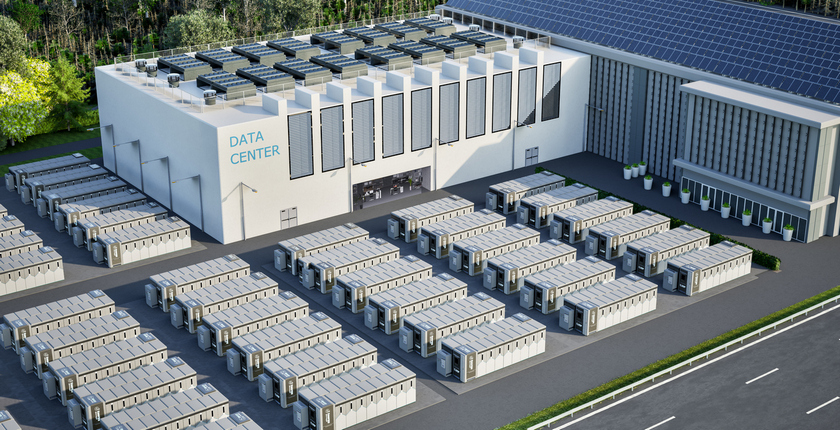
As AI data centers consume an increasing share of grid capacity, the role of on-site energy storage is expanding beyond providing an uninterruptible power supply, InfoLink noted.
Battery systems co-located with data centers can help balance power grids
This means that battery systems co-located with data centers are increasingly able to support grid frequency regulation, which could prompt more aggressive investment in storage by providers of power infrastructure for data centers, the consultancy explained.



Be the first one to comment on this article.