







Photo: Vilius Kukanauskas from Pixabay


Renewable gas injections in natural gas grids in the European Union have increased over the last two gas years to 4.3 billion cubic meters, according to the latest report of ENTSOG.
The European Network of Transmission System Operators for Gas (ENTSOG) has published its report on annual renewable gas injections into gas networks. It includes biomethane and renewable hydrogen. The observation period spans from October 1, 2023, to September 30, 2025.
Renewable gas injections have increased from 38.1 TWh to 43.2 TWh (approximately 4.3 bcm) over the last two gas years, an annual increase of 12 %, ENTSOG said.
This is ENTSOG’s second report on renewable gas injections into gas networks
The growth was driven by the commissioning of new biomethane plants and existing facilities reaching their nominal capacity, according to the report.
Renewable hydrogen was only injected into the German system. The volume decreased from 3 GWh to 1 GWh, the report reads.
Flows of biomethane outside of transmission system operator (TSO) and distribution system operator (DSO) grids aren’t included in the report.
This is ENTSOG’s second assessment of injection of renewable gases. The first one was included in its 2024 Annual Report, and published in April 2025, with data provided for the gas year 2023–2024.
Kuś: Biomethane market growth can be facilitated without the need for significant infrastructure investments
Piotr Kuś, ENTSOG General Director, said that renewable and low-carbon gases can be easily injected into natural gas grids, enabling the transport of sustainable and secure molecules.
He added that gas TSOs will continue to provide necessary infrastructure for these clean molecules to drive the energy transition.
“In particular, biomethane market growth can be facilitated without the need for significant infrastructure investments. This growth is essential if we are serious about meeting the EU’s REPowerEU target of 35 bcm biomethane by 2030,” Kuś stressed.
Five leading countries
Volumes of biomethane injections in the EU vary strongly between member states.
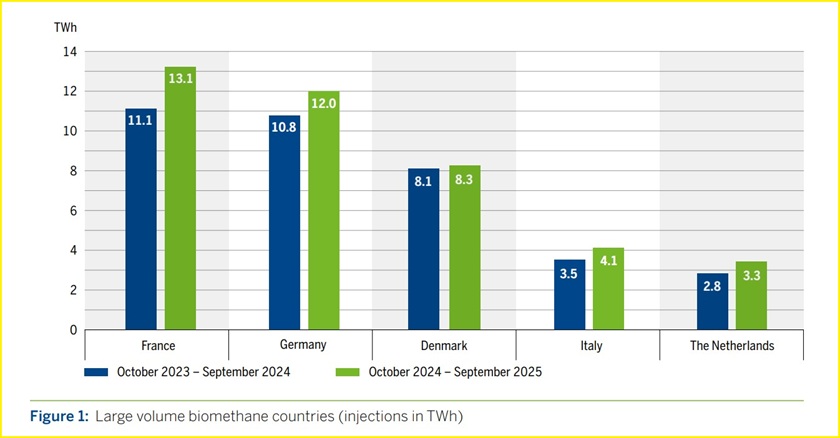
France, Germany, Denmark, Italy and the Netherlands accounted for 94% of the total renewable gas injections, the report reveals.
Some member states don’t report any injections – as, for instance, some have on-site consumption without the need for grid injections.
The five largest biomethane member states had significant increases in injections in TSO and DSO grids in the last gas year.
France saw a 2 TWh rise in injections, reaching 13 TWh in the last gas year (approximately 1.3 bcm), owing to the ongoing addition of new injection points, and existing production sites reaching their nominal operating levels, as it often takes some time for a site to achieve full output following its initial commissioning, according to the Report on Annual Renewable Gas Injections into Gas Networks.


Be the first one to comment on this article.