







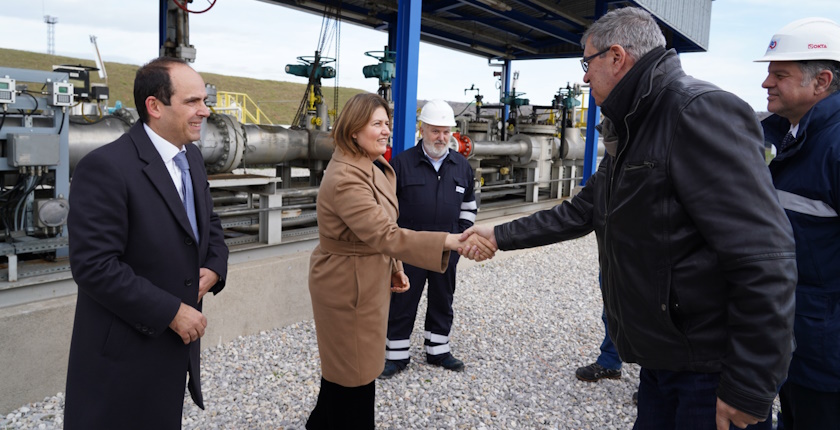
Photo: Ministry of Energy, Mining and Mineral Resources


Share


North Macedonian Minister of Energy, Mining and Mineral Resources Sanja Božinovska attended the final technical control and verification of the metering system of the product pipeline through which diesel fuel will be transported from HELLENiQ Energy’s Thessaloniki refinery to its long-defunct OKTA refinery in Skopje. The government owns 20% of the system, which is 213 kilometers long.
The repurposed pipeline from HELLENiQ Energy’s refinery in Thessaloniki, Greece, fulfilled the technical conditions for formal commissioning, North Macedonia’s Ministry of Energy, Mining and Mineral Resources said. The fuel supply line is resuming operation 13 years after the company closed the OKTA refinery in Skopje.
Minister of Energy, Mining and Mineral Resources Sanja Božinovska attended the final technical control and verification of the metering system. HELLENiQ will primarily transport diesel fuel.
Earlier, as initial operations were starting, the Greek company said the pipeline would facilitate deliveries to Kosovo*, southern Serbia and Bulgaria. Annual capacity is up to 2.5 million tons.
The oil pipeline wasn’t used since 2013, when the OKTA refinery ceased operations
North Macedonian Bureau of Metrology carried out the inspection, with representatives from the Czech Metrology Institute (CMI) and the Metron laboratory from Thessaloniki, and in the presence of representatives from the customs service.
“This is a significant step towards establishing a secure and modern system for the supply of derivatives. Precise measurement, control and international verification mean trust, stability and long-term energy security for the country,” Božinovska stressed.
The crude oil pipeline was put into operation in 2002. Its operator Vardax, a subsidiary of HELLENiQ Energy, is 20%-owned by the Government of North Macedonia, through Naftovod.
Transportation of diesel will reportedly cost EUR 20 per ton.
The infrastructure features 15 block valve stations, storage capacities of 80,000 cubic meters in Greece and 30,000 cubic meters in North Macedonia, and a SCADA (supervisory control and data acquisition) system for real-time pressure, temperature and flow monitoring.



Be the first one to comment on this article.