







Photo: CATL


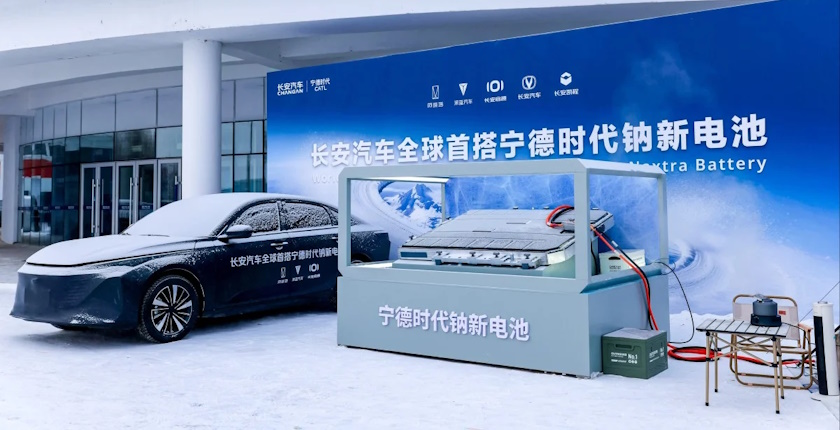
Chinese automotive manufacturer Changan presented the world’s first mass-produced passenger vehicle equipped with sodium ion batteries, in partnership with CATL. The companies are counting on its performances in extremely low temperatures, alongside fire safety.
Following a decade of research and development, Contemporary Amperex Technology Co. Ltd (CATL), the world’s biggest battery producer, reached one of the most important milestones with its sodium ion technology. State-owned China Changan Automobile Group unveiled the first-ever passenger vehicle implementing the solution on a mass scale.
The Changan Nevo A06 (Changan Qiyuan A06) sedan will reach the market by mid-year, according to the companies. It has a range of more than 400 kilometers, featuring the Naxtra battery of 45 kWh, according to the China Light-Duty Vehicle Test Cycle (CLTC) standard. Of note, grading in the West is stricter.
Naxtra is a cell-to-pack (CTP) system, in which cells are integrated directly, instead of through the intermediate module structure.
Safety gives special edge in EV market
The Changan Nevo A06 is not the first-ever vehicle on sodium ion batteries, but the engineers are ambitious about achieving mass production. The automotive producer intends to spread the Naxtra throughout its brand portfolio: AVATR, Deepal and UNI.
CATL acknowledged that sodium ion batteries are here to complement lithium ion solutions
The launch represents a major step in the industry’s transition toward a dual-chemistry ecosystem, where sodium ion and lithium ion batteries complement each other to meet diverse customer needs, CATL pointed out, confirming its course. It stressed that the technology is safe, reliable and with high performances.
Unmatched cold-weather performance, safety
CATL’s Naxtra sodium-ion battery achieves an energy density of up to 175 Wh per kilogram, setting the current benchmark for mass production. It is nearing the lithium-iron-phosphate (LFP) average.
As the sodium ion supply chain advances, ranges are projected to reach 500 or 600 kilometers, the manufacturer stressed.
It operates reliably even under extreme cold, delivering nearly triple the discharge power of equivalent LFP batteries at minus 30 degrees Celsius, while maintaining over 90% capacity retention at minus 40 and stable power delivery at temperatures as low as minus 50 degrees, CATL added.
Tested under tough conditions such as crushing, drilling, and sawing, the battery stays smoke- and fire-free and continues to provide power, according to the results.
Moreover, sodium costs a fraction of the price of LFP material.
Given the resistance to cold, the partners are looking to markets where air temperatures are lower to prop up electric vehicle sales. Lithium ion solutions are much more sensitive.
Ouyang Xiaolong, CATL’s head engineer for passenger cars, revealed to the South China Morning Post that more than 10,000 new battery units would be deployed this year. The plan is to reach “hundreds of thousands” in 2027.




Be the first one to comment on this article.