







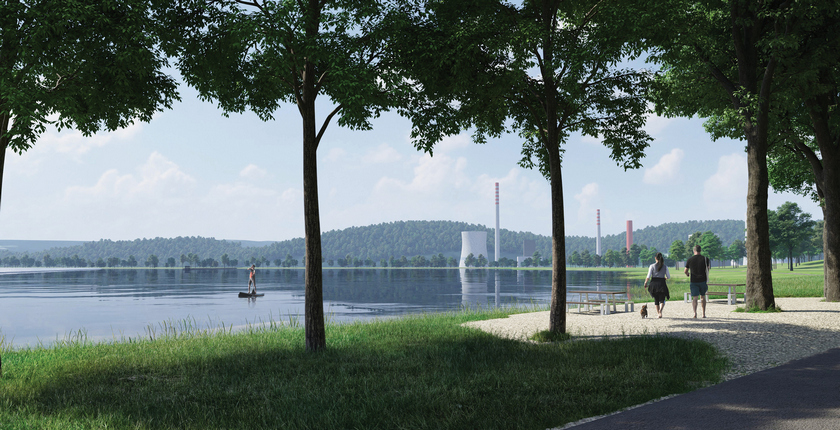
Photo: HSE


As the Government of Slovenia prepares to adopt a spatial plan for the country’s first floating solar power plant, the Municipality of Šoštanj, where the facility is to be built, says its support for the project will depend on tangible, measurable benefits for residents. According to Mayor Boris Goličnik, these conditions include annual compensation to the municipality, citizens’ participation in a solar energy community, and the demolition of a cooling tower at the nearby coal-fired power plant.
State-owned energy utility Holding Slovenske elektrarne (HSE), which is developing the floating solar project, said that the preliminary environmental impact assessment could be completed in the first quarter of 2027, and that the launch of construction is planned for the final quarter of that year if everything goes to plan.
The mayor of Šoštanj: Environmental acceptability is only the starting point
However, Goličnik said that environmental acceptability is only the starting point and that the local authorities expect concrete, measurable benefits for citizens once the project is operational, according to a report by Naš stik.
He added that the municipality’s support for the project is conditioned, among other things, on annual compensation, the demolition of the cooling tower of unit 4 at the Šoštanj thermal power plant, the inclusion of residents in the solar energy community, and the adoption of a national spatial plan to enable comprehensive development of the lake area.
Goličnik also said that the energy transition in Šoštanj must be aligned with the restructuring of the region following the closure of the Velenje coal mine, stressing that “energy projects must have clear benefits for people and the region.”
The planned capacity of the floating solar plant is 120 MW
The floating solar power plant is planned to be installed at the Družmirje artificial lake, next to Slovenia’s sole coal-fired power plant, Termoelektrarna Šoštanj (TEŠ). The project, valued at around EUR 110 million, envisages a capacity of around 120 MW, according to Naš stik.
At a presentation of the project last week, HSE said that the government was expected to adopt a decree on the spatial plan for the floating solar power plant in March, adding that the document would pave the way for producing a conceptual design and a more detailed environmental impact assessment.
The expected lifespan of the plant is around 30 years, and the cost of its eventual decommissioning is included in the investment estimate, according to the presentation.



Be the first one to comment on this article.