






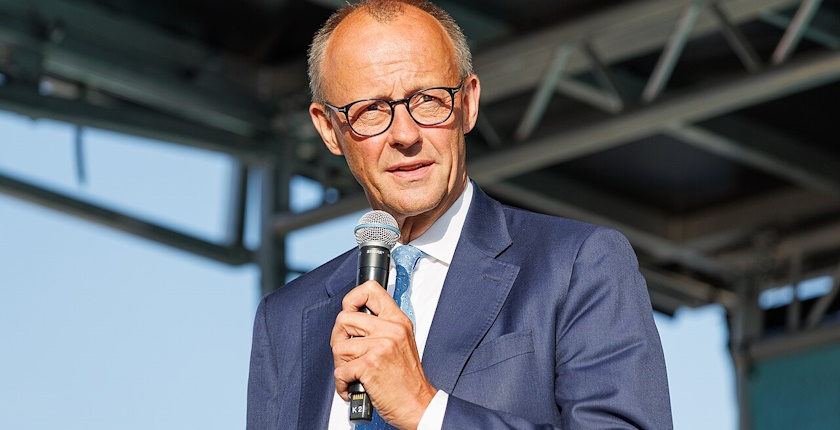
Photo: Steffen Prößdorf / https://creativecommons.org/licenses/by-sa/4.0/deed.en


The last nuclear power plants in Germany were closed three years ago. The government is charting a path for a revival, but with an alternative type of technology. Chancellor Friedrich Merz claimed nuclear fusion would introduce electricity so cheap that it would replace wind power within thirty years.
The participants in this week’s North Sea Summit in Hamburg committed to building 15 GW of offshore wind per year over 2031-2040. Country leaders including German Chancellor Friedrich Merz confirmed the goal of 300 GW on the so-called North Seas by 2050. At the same time, he apparently believes that wind turbines will begin to be dismantled much sooner!
Wind power is a “transitional technology” and it will be around for “ten, twenty, maybe thirty years,” Merz claimed, as quoted by Bild. He expressed confidence that Germany would put the world’s first fusion reactor online and estimated it would make electricity so cheap that no other generation methods would be needed.
Merz said repeatedly that the nuclear exit was a mistake
The country abandoned investments in nuclear power after the 2011 Fukushima disaster and prompted early closure of all reactors. Causing much controversy, especially during the recent energy crisis, the phaseout was completed in 2023.
In the campaign before last year’s elections, Merz called wind turbines ugly, adding that he’d like if they could eventually be taken down. He recently said the nuclear exit was a “huge strategic mistake” that caused “the most expensive energy transition in the entire world.”
New nuclear technologies on sites of former reactors
Merz has indicated that a nuclear revival is on the agenda, by using the sites of the closed facilities. However, so far he mostly promoted small modular reactors (SMRs) and other advanced technologies.
In the nuclear fusion process, two atomic nuclei fuse into one, unlike in fission, where the atom is split to release energy. The new technology is only experimental. Researchers in California were the first, in 2022, to generate more energy from nuclear fusion than the reaction required. The net gain is still insignificant, though.
Importantly, nuclear fusion is, in its essence, much safer than fission and it generates minimal radioactive waste.
More than EUR 2 billion for nuclear fusion from state coffers
Chancellor Merz’s cabinet said in October that the Fusion 2040 program and research support would entail EUR 1.7 billion in federal funding through 2029. It vowed to provide more than EUR 2 billion including other incentives.
German nuclear fusion startups earlier urged the government to facilitate the construction of pilot plants, so that the first commercial facility could be commissioned in late 2030s.
In Bavaria, there are projects for one demonstration system and two commercial-scale nuclear fusion plants.

Be the first one to comment on this article.