





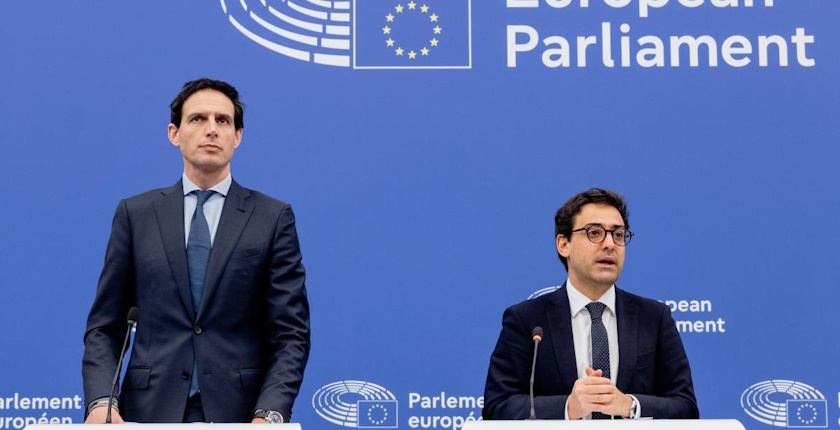
Photo from left: Wopke Hoekstra and Stéphane Séjourné (Valentine Zeler / EC - Audiovisual Service)


The European Union is further simplifying the Carbon Border Adjustment Mechanism (CBAM), but with stricter oversight and an extension to 180 steel- and aluminium-intensive downstream products. From January 1, importers of designated goods and commodities will be paying the emissions tax.
Among the novelties, countries in the Energy Community that transposed the relevant EU regulations are getting an opportunity for exemptions for CBAM for electricity earlier than initially planned. The new legislation is tackling the hurdles for electricity transit as well. The calculation of emissions on national levels in the same sector is becoming more favorable for the payers of the cross-border CO2 tax. There is even a possibility, in theory for now, to declare the actual emissions level, which would suit renewable energy producers.
In response to feedback from industrial producers and other stakeholders, the European Commission proposed measures to prevent circumvention of CBAM and strengthen its efficacy. The next step is to expand it to 180 manufactured products with high steel or aluminum content, 79% on average. The list mostly consists of machinery and hardware, and 6% of the items are household appliances.
From January 1, importers will be paying a carbon price within the Carbon Border Adjustment Mechanism, which is tied to the Emissions Trading System (EU ETS). It concerns aluminum, cement, electricity, iron and steel, hydrogen and fertilizers, and the expenses will spill over to their suppliers in third countries such as the Western Balkans and Turkey.
The charge for downstream products is planned to be rolled out in January 2028.
Striving for level playing field
The system gradually levels the field, by the beginning 2034, with producers of the same goods and commodities in the EU. The measures are introduced in the form of delegated and implementing acts. They enter into force if other institutions responsible for them, like the European Parliament, don’t block them.
Hoekstra: Our system was too broad, too clunky and had too many loopholes.
“CBAM makes sure there is a level playing field – that we’re not asking anything more, or asking anything less for those goods that come into the EU. And in doing so, we’re rewarding investments in low carbon… We’re not going to ask anything more from others, than we’re asking from ourselves. During the CBAM transition period, we learned important lessons. Our system was too broad, too clunky and had too many loopholes,” said European Commissioner for Climate, Net Zero and Clean Growth Wopke Hoekstra.
Thoroughly against evasion
The tax level is envisaged to be proportional to an established quantity of greenhouse gases released in production. However, if the authorities notice attempts to evade the levy, they can make the process of providing evidence stricter and, in the meantime, switch to a charge under the emissions factor of the particular country of origin.
“If I had to summarize these points in a few words, I would say: a simpler CBAM, more robust in its application, and fairer in its scope,” said the European Commission’s Executive Vice-President for Prosperity and Industrial Strategy Stéphane Séjourné.
Shortcut to exemption from CBAM for electricity
One of the measures is intended for easing the administrative burden for countries in the process of electricity market coupling with the EU, namely the Energy Community contracting parties.
There is going to be a possibility to sign an MoU with the European Commission with a detailed schedule
The commission may sign a memorandum of understanding with a third country, once the commission has assessed that the country has fully transposed the electricity market acquis, the proposal reads. The document would lay down details on the timeline for the CBAM exemption, including in relation to technical work still to be carried out between transmission system operators (TSOs), and for implementing a carbon pricing instrument equivalent to the EU ETS as far as electricity generation is concerned.
Hoekstra said technical adjustments to CBAM would be made to facilitate market coupling when the relevant countries are ready.
Import tax for electricity from Energy Community to be 30% lower on average
Stakeholder feedback and the experience with the implementation of CBAM during the transitional period – before the actual charge – demonstrated that the rules for electricity imports are overly rigid, the European commissioners added. In particular, they ascertained that progress in decarbonizing electricity production isn’t sufficiently acknowledged or encouraged.
Unlike with the goods, for electricity there is a default country-specific emissions value. It is based on production from fossil fuels and a five-year average. Coal is mostly dominant in the Western Balkans, except for Albania, which has a completely green mix. In addition, the conditions which must be met to declare actual emissions of electricity have proven to be almost impossible.
The proposed package is introducing solutions for electricity transit and cross-border PPAs
In the new setting, the national value will reflect the carbon intensity of all sources of electricity. The estimated taxes in the Energy Community would be over 30% lower on average.
The procedure is being streamlined for declaring actual emissions. On the other hand, at least in the Western Balkans, there has been almost no progress in that area. The proposed package is also introducing solutions for the hurdles in electricity transit through Energy Community Contracting Parties and cross-border power purchase agreements (PPAs).
Power imports from the Western Balkans account for 1% of the EU’s demand, but their share in Croatia, Bulgaria and Greece is significant, the European Commission explained. Importantly, exports of electricity to the EU represent some 58% of Montenegro’s exports to the EU, compared to 5% for Serbia and Albania.
Funds for maintaining competitiveness of domestic industrial producers in third countries
A fund has been launched to temporarily support EU producers of CBAM goods and mitigate carbon leakage risks. It addresses the competitiveness loss in third-country markets with a weaker climate policy and lower costs. Potential beneficiaries will have to demonstrate decarbonization efforts.
Th European commission is also preparing proposals for limiting scrap aluminum exports and using more scrap metal. Furthermore, it said pre-consumer metals scrap, from manufacturing, would come under CBAM.

Be the first one to comment on this article.