







Photo: iStock


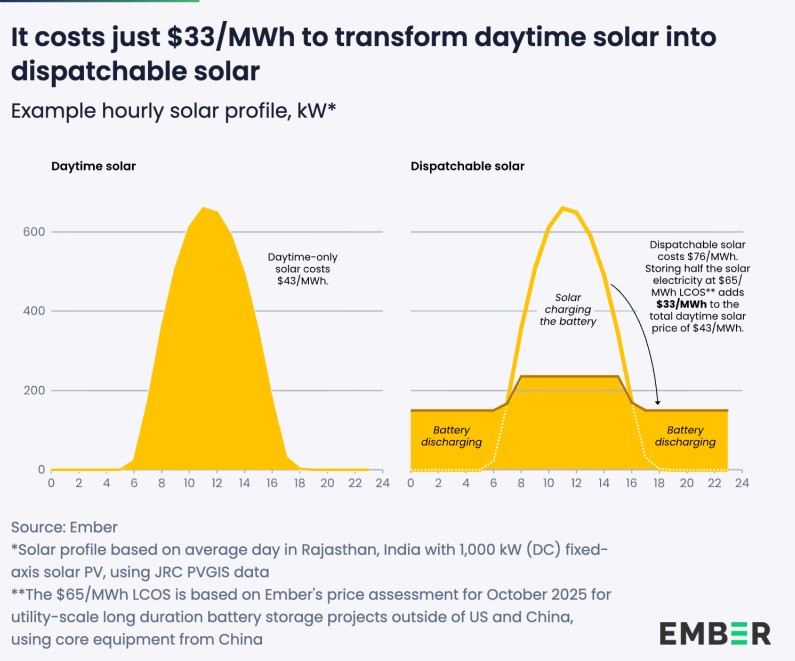
Turning cheap daytime solar electricity into a dispatchable profile results in a total electricity cost of USD 76/MWh, according to the latest analysis by Ember.
Ember’s assessment of storage costs is based on recent auctions in Italy, Saudi Arabia and India and on expert interviews.
Across global markets outside China and the United States, the total capex to build a long-duration (four hours or more) utility-scale battery energy storage system (BESS) project is around USD 125/kWh, the study reads.
The price combines USD 75/kWh for the core equipment shipped from China and USD 50/kWh to install and connect the battery.
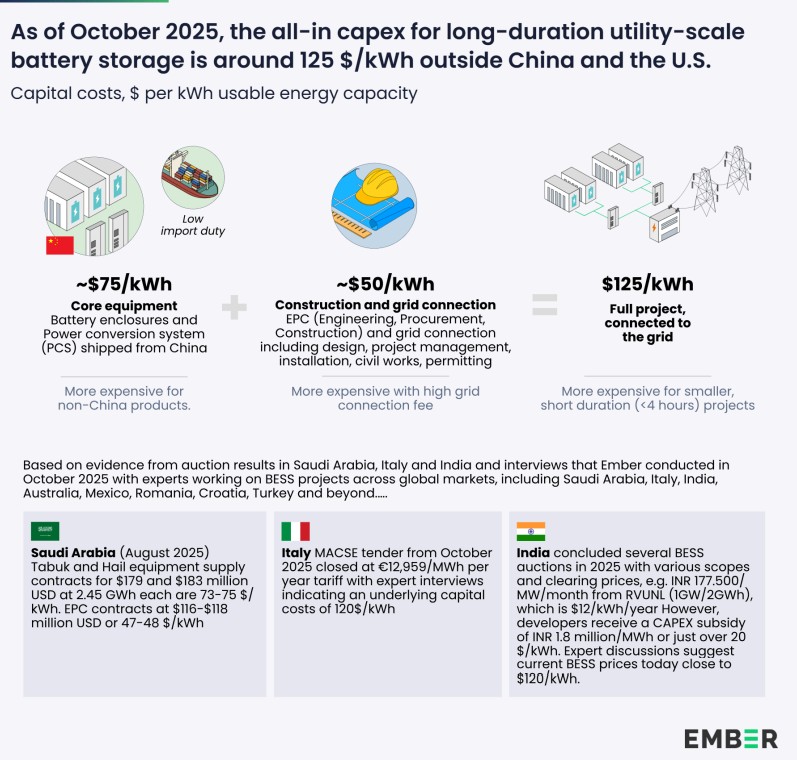
The authors of the analysis calculated a levelized cost of storage (LCOS) to be USD 65/MWh.
The metric reflects the cost of shifting one megawatt-hour to another time, such as moving daytime solar to nighttime. It doesn’t include the cost of electricity to charge the battery.
This low LCOS is not only the result of cheaper batteries, given that longer lifetimes, higher efficiencies and lower financing costs thanks to clearer revenue models like auctions have all helped to push the indicator down sharply, according to the analysis.
With the cost of storing electricity at USD 65/MWh, storing 50% of a day’s solar generation for consumption in nighttime hours adds USD 33/MWh to the total cost of solar. The authors used IRENA’s global average price of solar in 2024 of USD 43/MWh.
Delivering constant power every hour of the year requires solar overbuild and more battery storage
Turning this cheap daytime electricity into a dispatchable profile that is closer to an actual demand profile, would therefore result in a total electricity cost of USD 76/MWh, the analysis reads.
The authors stressed that this isn’t the same as baseload solar. Delivering constant power every hour of the year, including cloudy weeks and seasonal lows, requires solar overbuild and more battery storage, they added.
However, shifting half of daytime solar is a major step that aligns solar generation more closely with a typical demand profile, meaning solar can meet a much larger share of the evening and nighttime demand, the authors explained.

Kostantsa Rangelova, Global Electricity Analyst at Ember, pointed out that after a 40% fall in 2024 in battery equipment costs, another major drop is clearly on track in 2025.
“The economics for batteries are unrecognizable, and the industry is only just getting to grips with this new paradigm. Solar is no longer just cheap daytime electricity, solar is now anytime dispatchable electricity. This is a game-changer for countries with fast-growing demand and strong solar resources,” she is convinced.
Cheap batteries will enable solar to meet the majority of global energy growth
The analysis cited a projection from the IEA’s latest World Energy Outlook that in the next decade, 80% of global energy demand growth would come from regions with high-quality solar irradiation.
For these countries, combining solar with storage is now the most affordable path to meet soaring demand, improve energy security and reduce dependence on fossil fuel imports, according to the analysis.
It is an opportunity to develop clean industries
Dispatchable solar with a price of USD 76/MWh is cheaper and quicker than building a new gas power plant, especially if the country relies on more expensive LNG imports, they stressed.
The authors also pointed out that the installation of BESS could help the development of clean industries.
Even when core BESS equipment is imported, roughly 40% of total project value (about USD 50/kWh out of USD 125/kWh) remains local through engineering, civil works, grid connection and other EPC activities, the analysis reads.



Be the first one to comment on this article.