







Foto: BGEN


Unless the rules are refined for the electricity sector, the Carbon Border Adjustment Mechanism (CBAM) risks undermining the European electricity market integration and security of supply, Brussels-based think tank Bruegel warned.
Bruegel has analyzed the impacts of the application of CBAM, set for January 1, 2026. The tax will apply to steel, cement, iron, aluminium, fertilizers, hydrogen, electricity, and also to the cross-border trade in electricity.
The think tank proposes the application of CBAM in the electricity sector to be reconsidered, or at least for it to be postponed until 2028.
“Including electricity from January 2026 risks undermining European electricity market integration and security of energy supply, while the climate benefits are unclear. A delay could form part of a constructive compromise in an ongoing CBAM revision,” Ben McWilliams, Rouven Stubbe and Georg Zachmann wrote.
Ukraine and the Western Balkans will face implied export penalties of EUR 70-80 per MWh
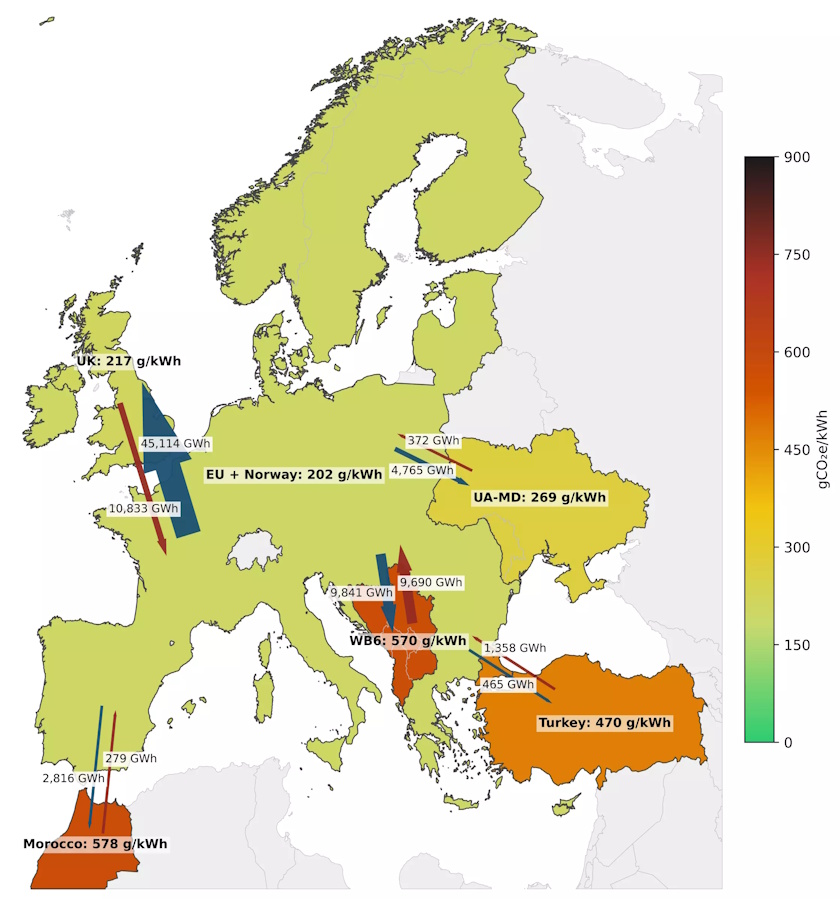
The trading partners affected by CBAM on electricity are the United Kingdom, Morocco, the Western Balkans – Albania, BiH, Kosovo*, Montenegro, North Macedonia, and Serbia – Ukraine, Moldova and Turkey.
According to the analysis, Ukraine and the Western Balkans will face implied export penalties of EUR 70 per MWh to EUR 80 per MWh. It will significantly reduce trade with the EU, the authors stressed.
Ukraine’s electricity exports to the EU are expected to drop more than 60% from the level in a scenario without CBAM – from 6 TWh to 2.5 TWh, they added.
Additional trade barriers on the EU’s eastern borders would slow electricity market integration.
The export of solar power from Greece to other EU countries could also be affected by CBAM
“Falling average electricity prices, lower market values for renewables and increased price volatility would also reduce incentives to invest in renewable assets in these countries. Moreover, the Western Balkans is an important transit region for intra-European electricity trading. The export of solar power from Greece to other EU countries, for example, could also be affected by CBAM,” the analysis reads.
The authors said the policy goal of integrating Energy Community countries into the EU’s internal energy market is strategically more important than addressing carbon leakage and argued that, in the long run, it is more important from a climate perspective, too.
Not clear whether the application of CBAM to the electricity trade will deliver
They recalled that the purpose of CBAM is to reduce the risk of so-called carbon leakage, as well as to encourage third countries to implement domestic carbon pricing.
“However, it is not clear that the application of CBAM, as currently designed, to the electricity trade will deliver on either front,” the authors said. They named two reasons why carbon leakage in the electricity sector is problematic. The free allowances issued to electricity producers under the ETS were already phased out in 2013 – implying that electricity is not considered by the European Commission to be a sector at serious risk of carbon leakage.
The current CBAM legislation is not clear enough
Secondly, the current CBAM legislation is not clear enough. Unless hard-to-fulfil conditions apply, the Regulation (EU) 2023/956, which established CBAM, proposes that default carbon emission values be applied.
The outcome is that the values in question are calculated according to the last five-year average CO2 intensity of electricity produced from fossil fuels. It is problematic because electricity is exported when prices in one grid are lower than in another, which typically happens when renewables output is high, the think tank underlined in its analysis.
It is also unfair because power systems are evolving – production from fossil fuels is decreasing and renewables generation is increasing.
The coupling of the electricity markets of Energy Community countries is unlikely before 2028
Regarding CBAM’s intention to push third countries to introduce carbon pricing, the authors said that the first developments indicate some results.
However, they explained that an exemption for the electricity sectors of third countries is available under certain conditions, including electricity market coupling and the introduction of an ETS with an equivalent price to the EU ETS by 2030.
The CBAM charge sets off in January 2026, and the coupling of the electricity markets of Energy Community countries is unlikely before 2028, which means that an exemption for electricity cannot be secured before that date under current rules, the analysis underlined.
The solution
The authors pointed out that the potential gains from including electricity in CBAM are limited, compared to the frictions it will create. They suggested to the EU to follow the lead of the UK, which doesn’t plan to include electricity in its own CBAM, and thus to drop electricity from its sectoral coverage.
Otherwise, the authors proposed a revision of the calculation of default carbon emissions, and application delay until 2028 with additional analysis on the risk of carbon leakage in the electricity sector.
Regarding the default carbon emissions, five-year average CO2 intensity should be substituted for average grid emission factors calculated on an hourly or 15-minute basis, administered by the European Network of Transmission System Operators for Electricity (ENTSO-E) and national transmission system operators.
The application of CBAM to electricity should be delayed until 2028 to avoid disruption to the electricity trade and to give more time for the introduction of domestic carbon pricing and the coupling of electricity markets, the authors of the analysis concluded.




Be the first one to comment on this article.