






Photo: Point & Shoot on Unsplash


The volumes of PPA deals in Europe that Pexapark tracks have dropped 62% month over month in January, and 14% on an annual basis, to 790 MW. The firm’s PPA price index EURO Composite grew 1.5% from December, to 52.53 EUR per MWh.
Throughout the first month of 2025, all tracked energy commodity prices moved upwards, Pexapark said in the February edition of its PPA Times. In January, prices of power purchase agreements or PPAs across Europe experienced mixed movements. Pexapark’s EURO Composite index closed the month 1.5% stronger than in December, at EUR 52.53 per MWh.
The yardstick is based on 10-year pay-as-produced (PAP) prices. It is a rolling average of the front- and second-year starting contracts. The trends do not reflect actual transaction prices, and should not be used for benchmarking PPA prices, the firm pointed out.
Germany’s Cal26 power contract ended January 11% up month on month, at EUR 98.21 per MWh – the highest since November 24, 2023. Power prices closely mirrored gas price movements, with the Cal26 Dutch TTF gas contract gradually rising throughout January and closing at EUR 40.8 per MWh, marking a 14-month high. A cold snap and low wind generation contributed to the upward pressure on gas prices. Additionally, colder temperatures in Asia increased competition for LNG, further supporting price increases, the report notes.
Allowances within the European Union’s Emissions Trading System (EU ETS) jumped 15% to close the month at EUR 83.93 per ton of carbon dioxide equivalent.
PPA prices in Nordics, Spain slide alongside electricity futures
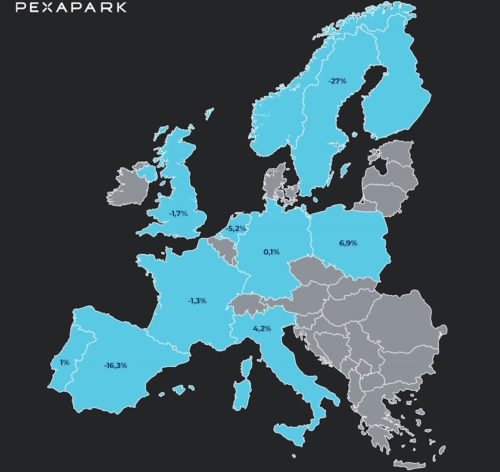
The Nordics had the largest decline in PPA prices, 27%. The downward move was driven by the Nordic Cal26 and Cal27 power futures prices, according to the update. The bearish movements were largely attributed to persistent wet and mild weather forecasts, with hydropower output substantially above the seasonal average.
Spain experienced the next-largest decline, 16.3%. The move mirrored declines in Iberian Cal26 power prices, which started the year at a one-year high of EUR 71 per MWh before steadily declining to close the month at EUR 64.78 per MWh. The initial spike was driven by cold temperatures and low onshore wind generation. However, strong wind output throughout the month supported bearish trends in the market. Poland and Italy recorded slight increases, in line with upward movements in their respective futures power markets during January.
Italy accounts for more than quarter of PPA volume
The first month of 2025 saw 25 PPA announcements totaling 790 MW of publicly disclosed volumes. It was 62% less than in December and 14% below January 2024. The deal count fell 7% month on month to 25, but it jumped 14% on an annual scale.
Italy took January’s geographical lead, with a total of 214 MW across eight PPAs. Vattenfall and LyondellBasell announced the largest deal of the month, after signing a 15-year offshore wind PPA for 450 GWh per annum, with an estimated PPA size of 107 MW, from the Nordlicht 1 project in the German North Sea.
In second place, Iberdrola maintains its presence on the leaderboard, this time with a virtual PPA signed with ArcelorMittal for 80 MW of onshore wind in Spain.
There is a growing trend toward signing PPAs with mixed technologies
Six announcements involved a mix of solar and wind technologies, totaling 243 MW, in France, Poland, Sweden and Denmark.
“While standalone solar has dominated the market for several years and continues to do so to a certain extent, there is a growing trend toward signing PPAs with mixed technologies. In 2024, out of the 316 publicly announced PPA deals in Europe and the total disclosed volumes of 15.2 GW, 10% of the deals and 18% of the capacity involved mixed technologies,” the document reads.
Standalone solar could be less appealing in certain markets, particularly for buyers seeking a firmer profile, according to the firm. Integrating solar and wind, which typically generate power at different times, enhances energy availability while mitigating exposure to volatile market prices.

Be the first one to comment on this article.