







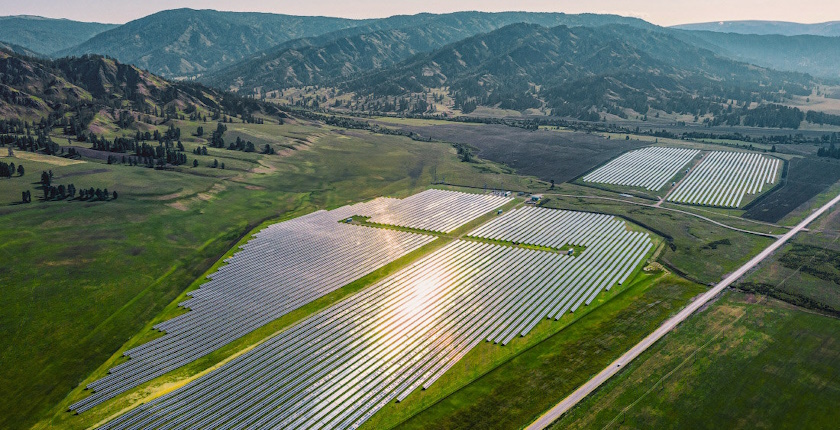
Photo: Rubets / https://creativecommons.org/licenses/by-sa/3.0/legalcode.en


After the first two, Turkey’s General Directorate of Highways is installing its third solar power plant and developing three more projects. Minister of Transport and Infrastructure Abdulkadir Uraloğlu said the ministry would build such facilities throughout the country.
Turkey’s General Directorate of Highways (KGM) put its first photovoltaic plant into operation in 2017. Satisfied with the savings, Minister of Transport and Infrastructure Abdulkadir Uraloğlu vowed to install them across the country. Photovoltaics are environmentally friendly and cost-effective and they decrease energy imports, he explained.
The Çeşme solar power plant has 1.05 MW in peak capacity and a 990 kW grid connection. Uraloğlu valued the contribution so far of the first facility, located near Izmir, at TRY 43.4 million (EUR 1.21 million). Interestingly, almost 100 kW is on canopies above a parking lot. Total output is 1.5 GWh per year, according to KGM.
Small unit in Elazığ scheduled to be brought online in August
The second one, in Van in Turkey’s far east, has 5.6 MW. Commissioned last year, it saved TRY 7.2 million (EUR 201,000) on an annual basis, the minister revealed. Another PV system, of 3.6 MW, will be built in the same area. Its savings are projected at TRY 4 million (EUR 112,000), Uraloğlu said.
The Kömürhan solar power plant in Elazığ in Eastern Anatolia is due to come online next month, the minister asserted. The construction in the village of Aladikme started on April 5. The facility’s peak capacity amounts to 1.23 MW. It is planned to generate 1.85 GWh per year for the lighting of the Kömürhan tunnel and save TRY 6 million (EUR 167,500) on an annual scale, he underscored.
Turkey’s Şanlıurfa Province, Istanbul join solar power portfolio
In addition, the ministry is planning a 5 MW in Şanlıurfa in Turkey’s southeast and a 5.2 MW unit in Istanbul for highways in the most populous city, Uraloğlu added. Works are underway on environmental impact assessment, he said.
KGM is entitled to payments for all surplus electricity that it delivers to the distribution network.
Turkey’s airports are also adding massive solar power capacity.
As for the rest of the region that Balkan Green Energy News covers, Slovenia has just started the procedure to use land owned by the state railways operator Slovenske železnice for solar power projects. There is also a plan from a year ago to build solar power plants along highways.


Be the first one to comment on this article.