







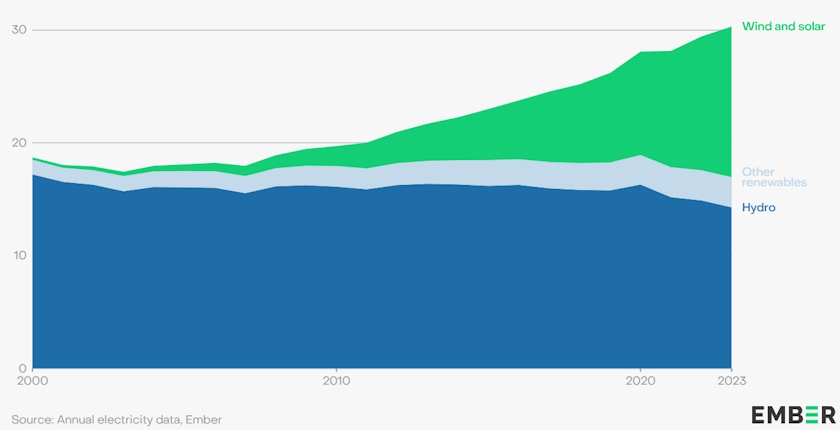
Photo: Share of global renewables generation in 2023 (Ember)


Renewables generated a record 30% of global electricity in 2023, driven by growth in solar and wind, Ember said in an annual report. Given the record construction of photovoltaic parks and wind farms last year, it likely marked the peak in emissions in the power sector, the think tank pointed out.
In its new Global Electricity Review, Ember analyzed electricity data from 215 countries, including the latest 2023 data for 80 countries representing 92% of global electricity demand. Renewables accounted for an all-time high 30% share of production, the document revealed. It compares to 19% from 2000. Solar power generation surge of 23% and the 9.8% rise in wind power output, in comparison to an increase of just 0.8% in facilities that run on fossil fuels are the think tank’s other main takeaways.
The report’s authors estimated that last year marked the peak in emissions in the power sector, though it made the same claim a year ago, too.
More than half of economies, 118 of them, are already at least five years past their peak. Their combined emissions have fallen by a quarter in the last decade. Collectively, they represent 43% of global electricity demand.
Jones: Renewables future has arrived
Wind and solar generation continued to expand faster than any other source of electricity. Together they reached a new record high of 13.4% (3.94 PWh) in 2023, gaining 1.5 percentage points of the global electricity mix from the year before. China was the main contributor, accounting for 51% of the additional global solar generation in 2023 and 60% of new global wind generation.
Together the top four solar growth economies – China, the European Union, United States and Brazil – had an 81% share in solar power growth in 2023, Ember underscored.
With nuclear power in the equation, low-carbon technologies provided almost 40% of electricity production
Combined with nuclear, the world generated almost 40% of its electricity from low-carbon sources.
“The renewables future has arrived. Solar in particular is accelerating faster than anyone thought possible. The decline of power sector emissions is now inevitable,” said Ember’s Global Insights Programme Director Dave Jones.
Drought setback in hydropower kept renewables below equivalent of total demand growth
The expansion of clean capacity would have been enough to deliver a fall in global power sector emissions in 2023. However, drought caused a five-year low in hydropower and a record year-over-year drop, of 88 TWh to 4.21 PWh. It created a modest shortfall against electricity demand growth, so it was met in large part by coal.
The growth in solar power output, of 307 TWh or 23%, outpaced wind (206 TWh and 9.8%, respectively), for the second year in a row. Photovoltaics reached a 5.5% share of the global electricity mix (1.63 PWh) 0r 0.9 points more than in 2022. Wind still provided a higher share of global electricity, 7.8% (2.3 PWh).
Solar added more than twice as much new electricity as coal in 2023 and it was the fastest-growing source of electricity for the 19th year in a row.
Despite reaching new record highs, the absolute growth in wind and solar power was below expectations and slightly smaller than in 2022. Ember noted that the increase in wind output was 18% lower than in the year before.
Global electricity demand rose by 627 TWh to a record high. On the other hand, the most notable declines were registered in the US (1.4%) and the EU (3.4%). In contrast, the rapid demand growth in China (6.9%) was equivalent to the total global growth in demand in 2023.
Greece has world’s second-highest share of solar power production
As for the region that Balkan Green Energy News covers, Greece had the second-highest share in solar power production in the world, 19%. The list excludes countries with less than 5 TWh in annual output. Chile topped the chart, with 19.9%. Hungary was third (18%), followed by the Netherlands (17%).
Turkey generated 118 TWh of power from coal, trailing only Germany (121 TWh) in Europe in absolute terms. Poland was ranked third, with 97 TWh.
In 2013, 25% of power was from coal in both Turkey and the EU. In 2023, the share in the EU dropped to an all-time low of 12%. In Turkey it reached a record high 36%. All fossil fuels accounted for 58% of the country’s electricity, while wind accounted for 10% and solar power had a 6% share.



Be the first one to comment on this article.