







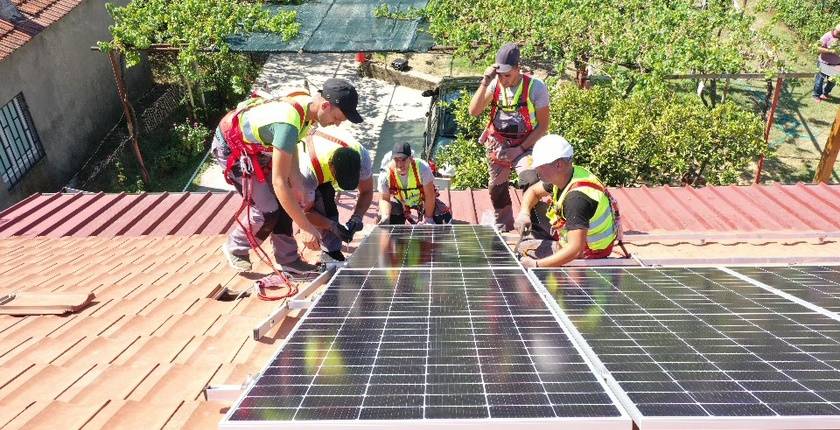
Photo: EPCG


The solar workforce in the European Union grew by almost 200,000 people in 2022, to 648,000. It translates to a 39% jump and reflects last year’s record 47% increase in new solar installations. The headcount is set to hit 800,000 in 2023, and reach 1.2 million by 2027, meaning that the number of jobs in the photovoltaic sector is basically going to double in just five years, according to the EU Solar Jobs Report.
SolarPower Europe earlier said 2022 was the year when the solar age truly began. However, despite the upsurge, the association recently warned that the European solar industry may face a wave of bankruptcies.
Employment in the sector was equivalent to approximately 648,000 full-time equivalent positions (FTEs) last year. Direct employment accounted for 281,000 FTEs or 43% of the total and the remaining 367,000 are classified as indirect jobs, the report reads.
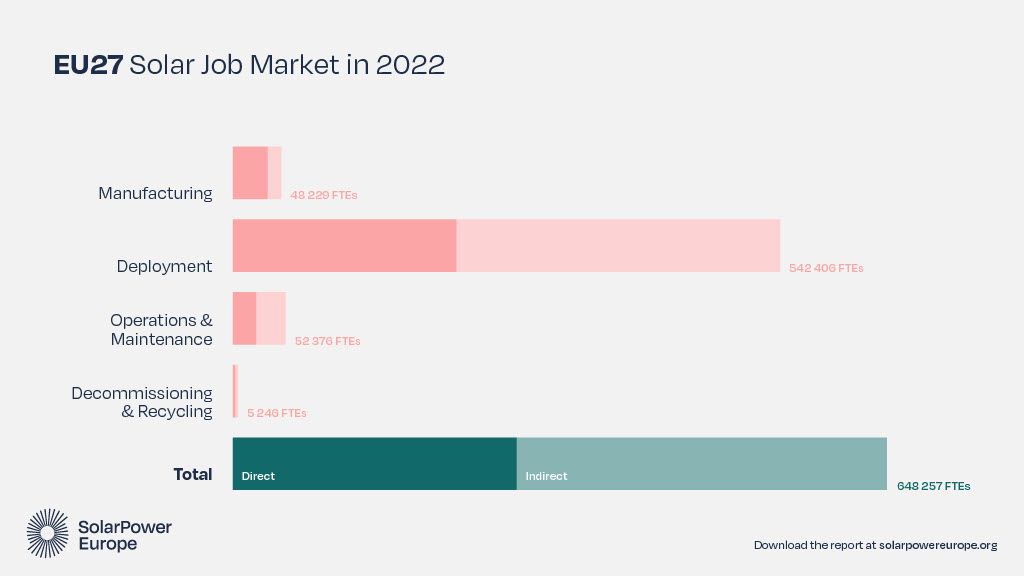
The majority of solar jobs (84%) were in the deployment of solar systems. Approximately 8% was registered in operation and maintenance, while manufacturing accounted for 7%. Decommissioning and recycling accounted for a mere 1%.
The year 2022 has also been pivotal as operation and maintenance jobs surpassed the ones in the manufacturing sector. SolarPower Europe said it reflects the discrepancies between the installation rates of solar power plants and the slow expansion of the local supply chain.
Solar rooftop jobs represented 73% of deployment, while the utility-scale segment covered the other 27%. Rooftops accounted for more than half the solar jobs in the seven countries with the highest employment in the sector: Poland, Spain, Germany, the Netherlands, Italy, Greece, and France.
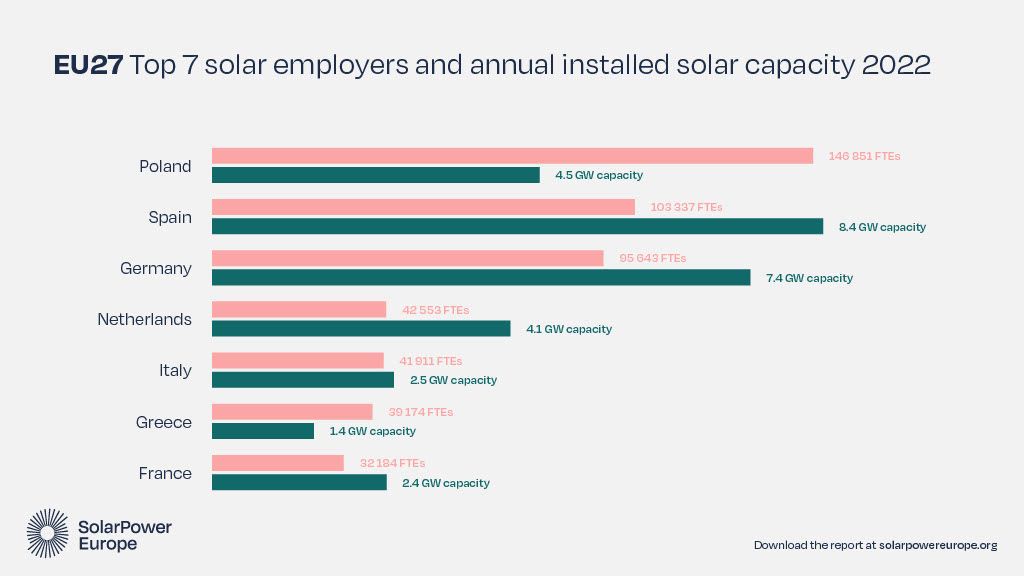
Poland remained in the lead – a testament to its large residential solar sector – with almost 150,000 jobs. Spain and Germany follow, respectively, each with around 100,000 solar workers.
“Looking at the solar skills gap, we’re beginning to tackle quantity, and now we need to re-double our efforts on quality. Citizens and businesses must feel confident that their solar project is manufactured, installed, and maintained by properly trained, trustworthy professionals,” said Walburga Hemetsberger, CEO of SolarPower Europe.
EU lacks workers in solar sectors… but which workers exactly?
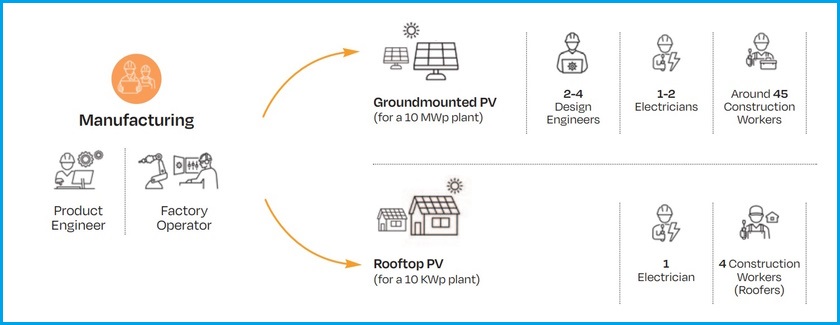
SolarPower Europe stressed that Europe lacks workers in the solar sector, but not all types of workers. The most needed are design and electrical engineers, as well as construction workers.
According to the report, design engineers are particularly critical for the utility-scale segment. There is fierce competition for engineering talents, while the proportion of science, technology, engineering, and math (STEM) students in Europe decreases.
Electrical engineers are critical for the appropriate design and safe grid connection of the photovoltaic systems, and they are a particular bottleneck for rooftop PV systems.
SolarPower Europe described construction workers as “the hands of the solar revolution.”
The rooftop PV market is impacted by a lack of roofers and construction workers, the report reads. The utility-scale subsector could be significantly impacted by the lack of construction workers, especially with the impressive growth of the project’s commissioning after 2022, it added.
The report also shares seven policy recommendations to secure the solar workforce that Europe needs.




Be the first one to comment on this article.