








Photo: iStock


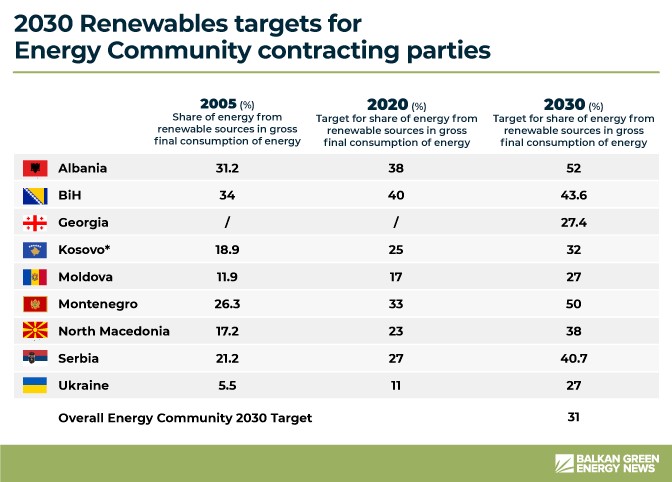
The Energy Community has announced individual targets for contracting parties for renewables, greenhouse gas emission cuts, and energy efficiency for 2030.
The announcement of the individual targets comes days after the Energy Community Ministerial Council published overall targets for the nine contracting parties – Albania, Bosnia and Herzegovina, Georgia, Kosovo*, Moldova, Montenegro, North Macedonia, Serbia, and Ukraine.
The individual renewables goals range from 27% for Ukraine to 52% for Albania. Compared to the 2020 targets, the largest increase among Western Balkan states is planned for Montenegro, and the lowest for BiH. If the goals are met, Albania and Montenegro will cover 50% of gross final energy consumption with renewables.
The overall target for all contracting parties is 31%.
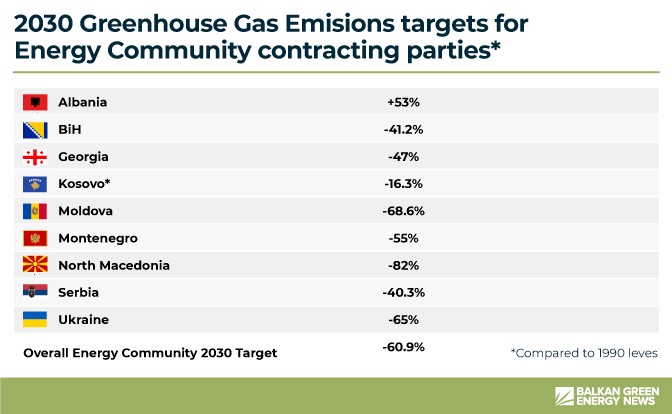
For the first time, contracting parties have been given targets for greenhouse gas emissions.
The largest reduction of GHG emissions is set for North Macedonia – 82% compared to 1990 levels, while the lowest is reserved for Kosovo* – 16.3%.
Albania will be allowed to increase its emissions by 53.2%.
The targets cover all domestic net greenhouse gas emissions of the contracting parties, including LULUCF emissions and removals, except for Montenegro.
The Ministerial Council agreed that all nine contracting parties have to lower GHG emissions by 60.9% against 1990 levels.
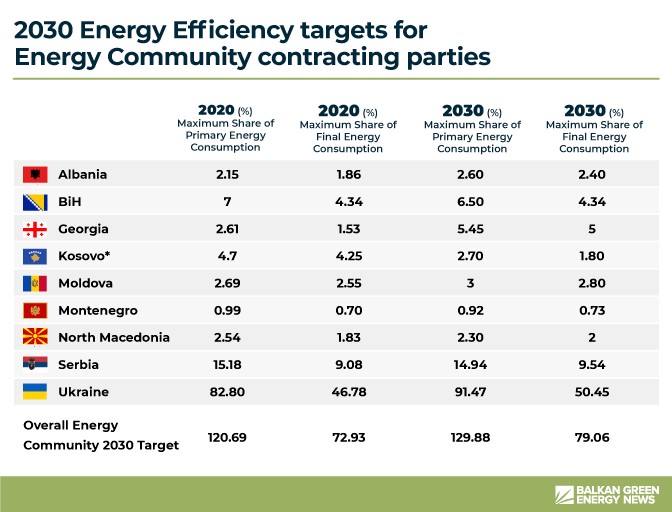
The contracting parties also received targets for primary and final energy consumption.
The largest reduction in primary energy consumption is planned for Kosovo* from 4.7 to 2.7 million tons of oil equivalent. The same contracting party will also have to achieve the biggest reduction of final energy consumption.
It is interesting that almost all countries, except Kosovo*, will increase not reduce the consumption of final energy.
Earlier, the council agreed to cap the primary energy consumption of all contracting parties at 129.88 megatons of oil equivalent and the amount of final energy consumption at 79.06 megatons.




Be the first one to comment on this article.