








Photo: Brightfreak from Pixabay


Swedish lawmakers supported the proposition to include CO2 emissions from the production and transport of imported goods in the country’s climate targets. By doing so, Sweden intends to further reduce and limit emissions from consumption. The Scandinavian country already has high ambitions and strives to reduce emissions to zero by 2045 at the latest.
World countries have been accounting for their carbon footprint only emissions produced strictly within their own borders. Sweden has now extended the calculation to emissions from products and goods the country purchase abroad.
The Swedish parliamentary environmental committee voted to include CO2 emitted in the production and transport of goods from abroad in the government’s climate reduction targets, which would make it the first country worldwide to make such a move and raise the bar in the fight against climate change.
The carbon footprint of imported goods
About 22% of global CO2 emissions originate from goods produced in one country and transported and consumed in another, the European Geosciences Union estimates.
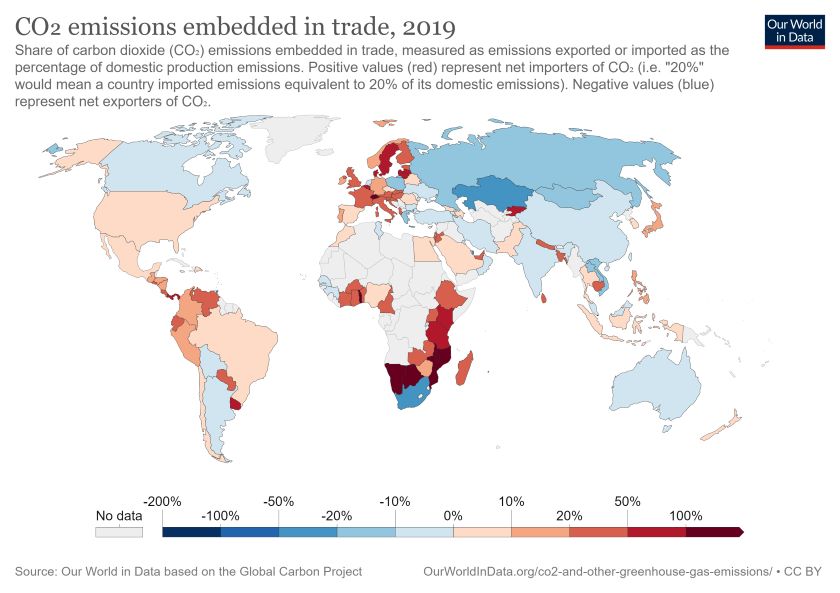
In Sweden, the percentage is almost three times higher. More than 60% of the country’s emissions recorded in 2019 originated abroad and are embedded in imports, according to Global Carbon Atlas.
According to the EIB, as many as 76% of Sweden citizens would support stricter measures to change behavior patterns
According to a survey by the European Investment Bank, as many as 76% of the country’s residents would support their government in introducing stricter measures to change behavior patterns concerning the carbon footprint.
Replenishment for CBAM
All eight political parties in the Swedish parliament agreed to expand climate policy that way. Accordingly, the country would assume responsibility for the carbon footprint of imported goods in the near future. The recommendation voted by the committee is yet to be formally adopted.
Political parties in the Swedish parliament consent to the extension of climate policy
The proposal is set to push Sweden into the field of complex methodology of calculating and reporting emissions made outside its territory, while the details have yet to be elaborated, Climate Home News reported.
Sweden’s decision is a way to complement the European Union’s plan to impose a carbon tax on imports of certain goods with the Carbon Border Adjustment Mechanism (CBAM).
The Scandinavian country supports the CBAM scheme, which is due to enter into force in 2026 and will be applied for imports of cement, iron and steel, fertilizers, aluminum, and electricity.
Sweden will take into account the emissions emitted internationally for food, electronics, building materials, and a wide range of products
The new climate policy on consumption emissions is yet to be adopted by the Swedish government. It will take into account the emissions emitted internationally for consumer products imported by the state. The system is envisaged to cover food, electronics, building materials, and a wide range of products.
The climate initiative makes Sweden one of the leaders in the fight against climate change.




Be the first one to comment on this article.