







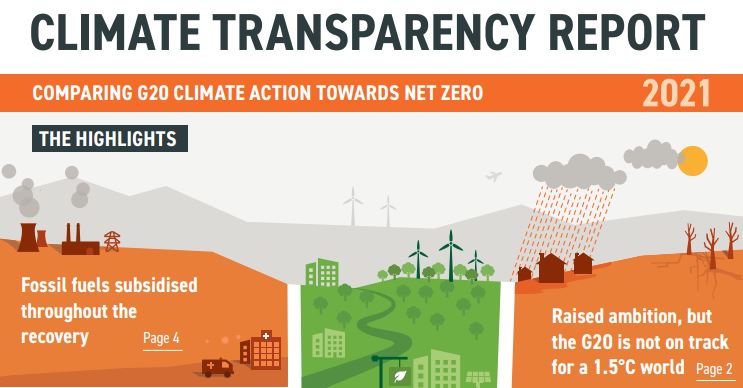


After a short period of decline due to the COVID-19 pandemic, greenhouse gas emissions (GHG) in the G20 countries are rising again, and are projected to rebound by 4% in 2021. The G20 governments need to come up with more ambitious national emissions reduction targets ahead of the UN climate summit COP26 in Glasgow, which opens on October 31, according to the Climate Transparency Report 2021.
Most G20 countries missed the opportunity to use COVID-19 recovery packages to promote climate mitigation goals, with only USD 300 billion of the total USD 1.8 trillion in recovery spending going to green recovery. At the same time, fossil fuels continued to be subsidized.
The world remains far from capping global warning at 1.5°C
Such a state of affairs is leaving the world far from meeting the 1.5°C global warming limit, warns the Climate Transparency Report, a comprehensive annual review of G20 countries’ climate action and their transition to a net-zero emissions economy.
Dependence on fossil fuels across the G20 group, which accounts for 75% of global GHG emissions, is not declining, according to the report. Coal consumption in G20 is projected to rise by almost 5% in 2021, driven by China (accounting for 61% of the growth), the United States (18%), and India (17%), while the consumption of natural gas has increased by 12% across the G20 from 2015-2020.
At the same time, experts who produced the report note that apart from the United Kingdom, G20 members have neither short- nor long-term strategies in place for achieving 100% renewables in the power sector by 2050.
Positive developments include new records of installed solar and wind capacities in 2020
The report also highlights some positive developments, such as new records of installed solar and wind capacities in 2020 and the expected growth of the share of renewables in energy supply, from 10% in 2020 to 12% in 2021.
Also, in 2021 renewables are projected to make up nearly 30% of the G20’s power sector (energy used to make electricity and heat).


Be the first one to comment on this article.