






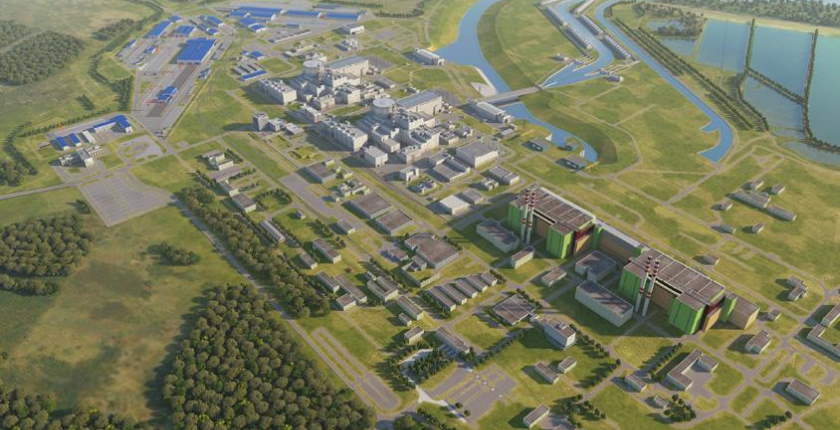
Photo: Paks II


Hungarian Foreign Minister Péter Szijjártó has agreed with Russia’s state nuclear construction company Rosatom that work on Hungary’s new nuclear plant at the central Hungarian Paks site would be accelerated in the autumn.
Hungary intends to expand its 2,000 MW Paks nuclear power plant with two units of 1,200 MW each. Two new units will replace all four currently in operation. Paks nuclear power plant consists of four 500 MW units, which started operations from 2006 to 2009, and are expected to be shut down between 2032 and 2037.
Foreign Minister Péter Szijjártó expects Rosatom to be able to begin construction next year
The nuclear power plant now generates 50% of domestic power production, and has a share of one third of the country’s electricity consumption.
According to Szijjártó, the Hungarian Atomic Energy Authority has until September to approve a licence application by Paks 2 Zrt, the state-owned firm developing the plant. He said he expects Rosatom to be able to begin construction next year, Reuters reported.
In November 2020, the Hungarian Energy and Public Utilities Regulatory Authority approved Paks II, but the Hungarian Atomic Energy Authority is yet to issue a construction licence.
The government is in talks with neighbouring countries to sell any excess electricity from Paks 2
Szijjártó, who is attending an energy summit in Saint Petersburg, said the government was already in talks with neighbouring countries to sell any excess electricity once the Paks 2 nuclear plant comes online, in about a decade.
The Paks nuclear power plant is owned by state-owned power utility MVM.
Hungary announced in March that it would close its last remaining coal-fired power plant in 2025 – five years earlier than initially planned.
Loan repayment delayed
A month ago, Hungary and Russia also agreed on delaying the loan repayment from 2026 to 2031. The Paks II investment is estimated at EUR 12.5 billion, of which EUR 10 billion is a Russian loan.
As a result of successful negotiations, the Paks II financial agreement can be changed in a favourable way for Hungary, the Hungarian Ministry of Finance said.
Hungary can start repaying the loan as of 2031 which means it can use the income from Paks to secure funds.
The change will not affect the interest rate, the ministry added.
The rescheduling of the loan repayment was needed mainly due to the length of previous investigations within the European Union, according to the ministry. The EU gave a green light in March 2017 for the financing deal for Paks II. It said the agreement doesn’t violate EU state aid rules.

Be the first one to comment on this article.