







Photo: Pixabay


Storms, floods, droughts and heat will disrupt the supply of chemicals as climate change impact grows, according to a report released by Lux Research, which cites hundreds of millions of dollars in damage so far on a global scale.
Climate-related hazards are poised to massively disrupt the chemicals industry, on top of the lost earnings so far, according to a new report. Lux Research outlined the necessary steps for the companies in the sector. It warned of “very real threats” to the production of chemicals due to climate change including the rise in carbon dioxide emissions.
“Coastal storms, inland flooding, extreme temperature, and drought will all have wide-ranging consequences. Serious impacts will include damage to capital assets, disruptions to transport and raw materials availability, and impacts on labor productivity and safety,” lead author Kristin Marshall stressed.
The senior research associate at Lux said the shift warrants mitigation steps and structural changes. “Our review of the climate change adaptation strategies found that there is no completely effective solution except to move out of the path of destruction,” she asserted.
Decentralize chemicals production
Marshall highlighted the role of small-scale and decentralized operations “even in the face of worse economics” and underscored risks apply even to producers not located along coasts.
The report offers example of the damage that BASF and the Dow suffered in extreme weather events
Shipping disruptions affected BASF and other producers due to low water levels on the Rhine and the Dow experienced flooding in Midland, Michigan, in the wake of Hurricane Harvey, according to the document, named ‘In the Path of Destruction: Preparing for Global Climate Change in the Chemical Industry’. The overall impact is measured in hundreds of millions of dollars. The report points to the examples of fermentation and electrochemical production that have the potential to be distributed into smaller facilities, reducing exposure of the supply chain.
Four areas for response to climate change
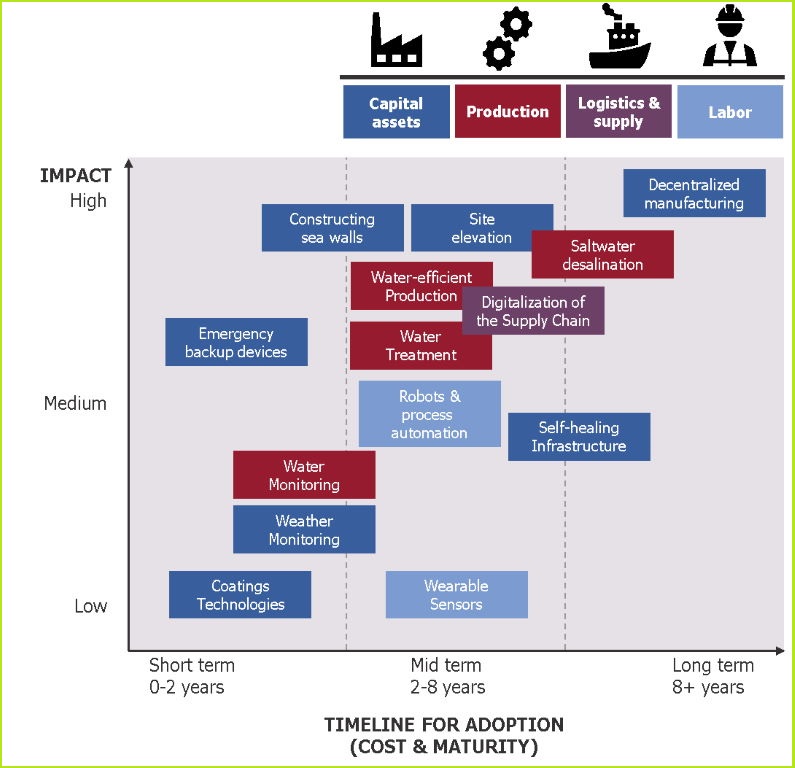
The climate change challenges for the chemicals sector are bound to strengthen in the next five decades and the producers of chemicals must work on ways to endure shocks in the long term across capital assets, production, logistics and supply and labor, the authors added.
They recommend investing in the future rather than spending on existing low-impact solutions. The strategy includes building analytics capabilities for collecting and incorporating climate data and modeling into risk management planning. The message is that successful companies will increase risk management budgets for vulnerable operations as higher-impact technologies become available and more needed.
Fortify or move
Companies are facing the need to measure the cost of protecting existing assets versus relocation and new business models.
Water treatment technology and efficiency in water use are some of the areas with the potential for progress
As for buildings, storage and equipment, there is the option to modify, but flood protection is seen as expensive, partly effective and time consuming. With growing water scarcity driving up production costs, producers are looking to strengthen their reuse efforts with improved water treatment technologies and are adopting more water-efficient processes, the report said and also called for digitization projects in the supply chain.




Be the first one to comment on this article.