






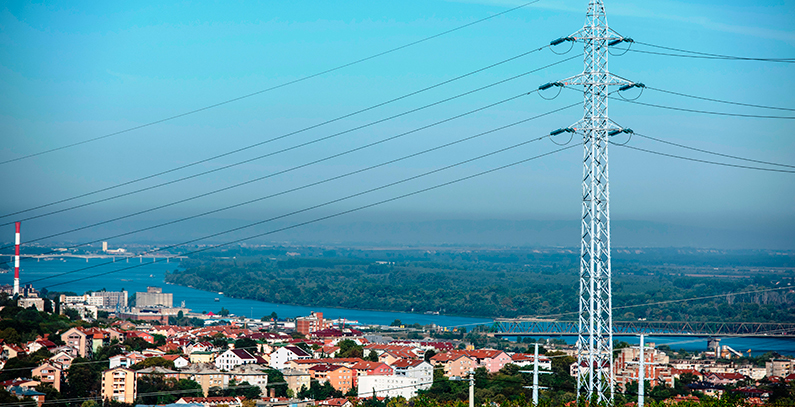
Photo: EMS


The Energy Agency of the Republic of Serbia (AERS) has approved the Transmission System Development Plan for 2019-2028 and the Transmission System Investment Plan for 2019-2021. The plans were adopted by state-owned company Elektromreža Srbije, Serbia’s transmission system operator (TSO).
In the Development Plan for 2019-2028, the list of production capacities expected to be connected to the grid includes 14 new wind farms, one new thermal power plant, a new generator at the Kostolac B thermal power plant (TPP), a generator with an increased installed capacity at TPP Nikola Tesla A, two new thermal power plants (TPP Pančevo and TPP Vinča), a new generator at hydropower plant (HPP) Potpeć, as well as four other generators with an increased installed power at other HPPs.
There are also five projects for the connection of facilities installed by the transmission system users, primarily intended to power new mines, the EMS said on its website.
The Investment Plan for the three-year period envisages investments that are important from a national, regional and European perspective, and whose implementation will have a significant impact on increasing the transmission capacity of the regional network as well as on the development of the electricity market in Europe.
The Development Plan for 2019-2028 also includes the completion of the first phase of the Trans-Balkan Corridor
The transmission network’s development planning is becoming an increasingly complex process because there is a growing number of requests for connecting renewable energy sources, while the EMS must also provide the infrastructural conditions for industrial development and fulfill its major task to ensure reliable and secure power supply and a sustainable development of the Serbian transmission system, having in mind the goals of the ENTSO-E Ten Year Network Development Plan (TYNDP), according to Nadica Stojanović, Executive Director of EMS Investment and Strategy.
The Development Plan for 2019-2028 also includes the completion of the first phase of the Trans-Balkan corridor. It includes the completion of the remaining three sections: Section 2 (400 kV power line from substation Kragujevac 2 to substation Kraljevo 3), Section 3 (2×400 kV power line from substation Obrenovac to substation Bajina Bašta), and Section 4 (2×400 kV power line between Serbia, BiH and Montenegro). Section 1 (2×400 kV power line between Serbia and Romania) was commissioned in December 2017.



Be the first one to comment on this article.