







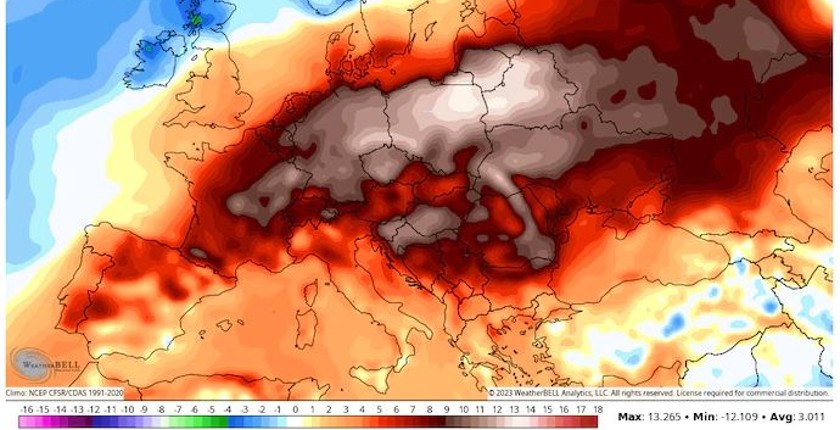
Phto: Colin McCarthy/Twitter


The first days of the New Year saw record high temperatures across Europe, ranging from 10 to 20 degrees Celsius. January 1, 2023 was the hottest ever recorded in eight countries. Scientists agree that this was an unprecedented extreme weather event, primarily due to its intensity – the old records were broken by large margins, not by half a degree or a degree, but by 4-5 degrees. For many of them, this is further evidence of climate change and a wake-up call for everyone, warning us that something must be done.
The springtime weather in December and January probably delights those who don’t like winter, but even they must be aware that these events are neither usual, nor normal. Increasingly hot summers – and we all remember the summer of 2022 – cannot bring anything good. In the sea of records, Belgrade also broke one of its own: the eighth year in a row without snow for New Year’s Eve!
The heatwave at the beginning of the year was best reflected in the night temperatures, which were around 19°C in some places in Poland and Switzerland, which is not only higher than the January but also the July average!
The heatwave in January affected fifteen European countries
According to data compiled by Maximiliano Herrera, a climatologist, the hottest January day ever was recorded in Belarus, the Czech Republic, Denmark, Latvia, Liechtenstein, Lithuania, the Netherlands, and Poland. In Korbielów, Poland, as reported by the Guardian, the mercury climbed to 19°C, a temperature typical of May and 18 degrees above the annual average for January.
Temperatures in Vysokaje, Belarus, usually hover around zero at this time of year, but the first day of 2023 saw 16.4°C, smashing the country’s record by 4.5 degrees.
This is the most extreme event ever seen in European climatology, according to Herrera, the Washington Post reported. He added that it can be compared to the 2022 UK heatwave, but now it has affected about fifteen countries.
We just observed the warmest January day on record for many countries in Europe.
Truly unprecedented in modern records. pic.twitter.com/bUux1XOBH9
— Scott Duncan (@ScottDuncanWX) January 1, 2023
Alex Burkill, a senior meteorologist at the UK’s Met Office, said that on January 1 we had extreme heat across such a huge area that it was almost unheard of.
He explained that a warm air mass that developed off the west coast of Africa moved northeast and entered Europe near Portugal and Spain, pulled by high pressure over the Mediterranean Sea.
The event was widespread, with Denmark, the Czech Republic, and almost all of Germany experiencing temperatures for January above the previous records, Burkill said.
The list of records is long
According to the Washington Post, these are some of the most impressive records set on January 1:
- In Poland, the national record was broken before sunrise, with 18.7°C measured in the town of Glucholazy at 4 am, which is higher than the average lowest temperature during the summer.
- In France, records were set at more than 100 measuring points, with a temperature of 24.9°C in Trois-Ville, and 24°C in Dax.
- In Germany, Ohlsbach was the hottest, with 19.4°C, while Berlin set its own record, of 16°C.
- The highest temperature in Warsaw, of 19°C, which broke its previous January record by 5.1 degrees.
High temperatures are a sign of even bigger problems
Meteorologist Scott Duncan pointed out that the causes are difficult to determine, and that it is certain the La Niña and the anomalous heat in sea surfaces contributed a lot. All this, in his words, is not new, but he believes that ever-warmer atmosphere and oceans are making it easier to break records.
Professor Bill McGuire, who deals with the consequences of the climate crisis, believes that high temperatures are a sign of even bigger problems.
What worries him most is that the speed of global warming is no longer a surprise. McGuire says everyone should prepare for short winters with dreary, wet and mild weather, with very little frost, ice or snow.




Be the first one to comment on this article.