


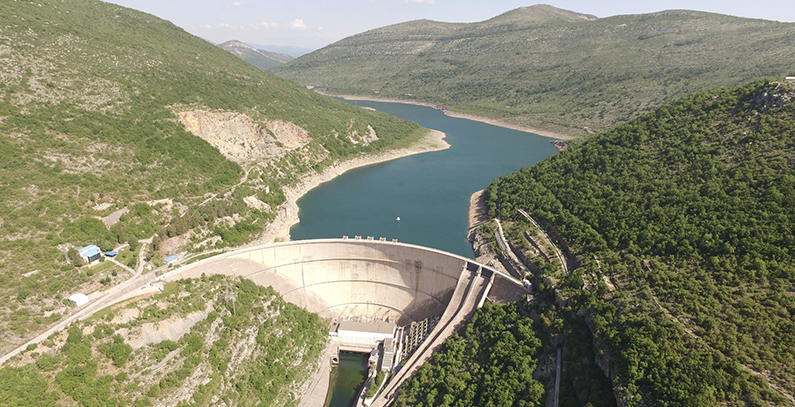
The United Nations Development Programme (UNDP) in Bosnia and Herzegovina has launched tendering for the development of study on the economic impact of climate change on the hydropower sector in Republika Srpska – the multipurpose hydrosystem Trebišnjica.
The deadline to file bid expires on July 25.
The UNDP in BiH is implementing the National Adaptation Plan (NAP), funded by the Green Climate Facility (GCF), and the development of a study on the economic impact of climate change on the hydropower sector in Republika Srpska – the multipurpose hydrosystem Trebišnjica in BiH is envisaged, the procurement notice reads.
The key objectives of the study are to analyze the climate change impact on the current state of development of the hydropower system and its efficiency. It is necessary to analyze the planned elimination of negative impacts in the current state and estimate the achievements for the current degree of development, the request for proposal reads.
According to the document, following the analysis of the current state, it is necessary to carry out an analysis of the ‘to-be’ state, i.e. the planned expansion of the Trebišnjica hydropower system in the planned state (the key facilities of the system that are missing – HPP Nevesinje, HPP Dabar, HPP Bileća and HPP Dubrovnik 2) as an alternative in combating climate change.
The facilities of the hydropower plant system on Trebišnjica are now used by power utility Elektroprivreda Republike Srpske (ERS) – HPP Trebinje 1 and HPP Trebinje 2, as well as one generator in HPP Dubrovnik G2, Elektroprivreda Herceg-Bosne (EPHZHB) – HPP Čapljina, and Hrvatska Elektroprivreda (HEP) – one generator in HPP Dubrovnik. The three companies are from two states, BiH and Croatia, including two from different entities of BiH.
Tendering for HPP Dabar underway
Power utility Elektroprivreda Republike Srpske (ERS) intends to build the 160 MW HPP Dabar. The tendering procedure for this project is in progress. In November 2018, ERS selected a consortium led by AF-Consult Switzerland Ltd. to provide advisory services in the process of awarding a turnkey/engineering, procurement, and construction (EPC) contract.
The multipurpose system of Trebišnjica, as an integrated development project, is a system with a very complex configuration, which is under gradual development.
The expansion of its current configuration is planned to the so-called Gornji Horizonti zone.
The current configuration of the system includes reservoirs of Bilećko Lake and Trebinje, as well as HPPs Trebinje 1, Trebinje 2, Dubrovnik 1 and Čapljina.