


Serbia’s state-owned gas company Srbijagas and Hungary’s power utility MVM signed an agreement to set up a joint venture called SERBHUNGAS, a gas trading firm based in Novi Sad, Serbia. The two countries also plan to build a cross-border oil pipeline.
The agreement on establishing SERBHUNGAS was signed following the first meeting of the Serbia-Hungary strategic cooperation council at Lake Palić in northern Serbia, which was attended by the two countries’ top officials.
Serbia’s Deputy Prime Minister and Minister of Finance Siniša Mali was earlier quoted as saying that the agreement would concern joint gas trading activities on the Serbian market.
Siniša Mali: The agreement concerns gas trading in Serbia
Serbian President Aleksandar Vučić said following the signature that Serbia was able to survive the winter thanks to sufficient gas supplies ensured by Hungary. Currently, there are 560 million cubic meters of gas stored for Serbia, which provides security for the upcoming winter as well, he added.
Previously, the Government of Serbia gave its consent for setting up the new company, following a decision by the Supervisory Board of Srbijagas, local media reported. The contract to establish limited liability company SERBHUNGAS was initialed by Dušan Bajatović, general manager of Srbijagas, and László Zoltán Fritsch, CEO of MVM CEEnergy.
MVM produces, distributes, and trades in electricity, but is also present in the gas sector. It operates nuclear power plant Paks.
MVM is entering a deal with Srbijagas just weeks after reports of a hydropower agreement with EPS were refuted
In May, local media reported that state power utility Elektroprivreda Srbije (EPS) would allegedly set up a joint venture with MVM and spin off 11 hydropower facilities for the purpose, with a total installed capacity of 350 MW. However, the Ministry of Mining and Energy denied the allegations.
Serbia-Hungary oil pipeline will diversify supply routes
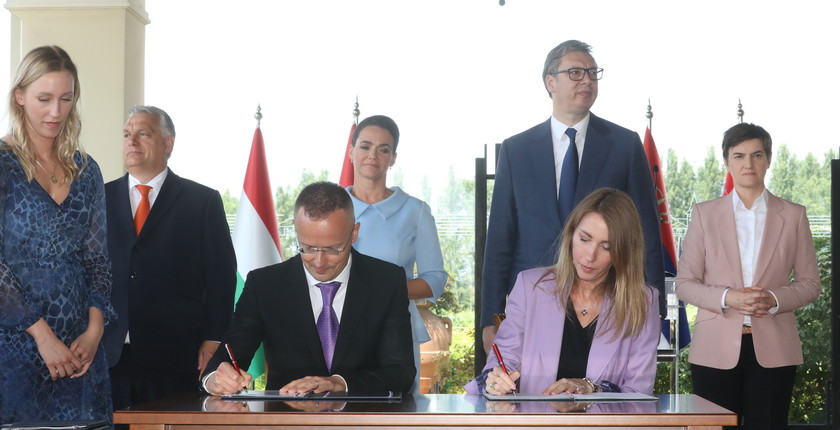
A series of documents signed at Palić includes a memorandum of understanding on the construction of the Hungary-Serbia oil pipeline. It was signed by Serbian Minister of Mining and Energy of Serbia Dubravka Đedović and Hungarian Minister of Foreign Affairs and Trade Péter Szijjártó.
The estimated value of the Serbia-Hungary oil pipeline, for a capacity of 5.5 million tons per year, is EUR 157 million for the Serbian section, according to a statement from the Ministry of Mining and Energy.
Đedović recalled that Serbia currently gets crude oil only through Croatia, and she noted that greater security requires a diversification of supply routes and sources. “By building a new oil pipeline to Hungary, we will ensure a safer supply for the domestic refineries, as well as the domestic market.” she said.
The signing of bilateral agreements in various fields, from migration and defense to customs and road infrastructure, was attended by Serbian President Aleksandar Vučić and Prime Minister Ana Brnabić, as well as Hungarian Prime Minister Viktor Orbán and President Katalin Novák.