

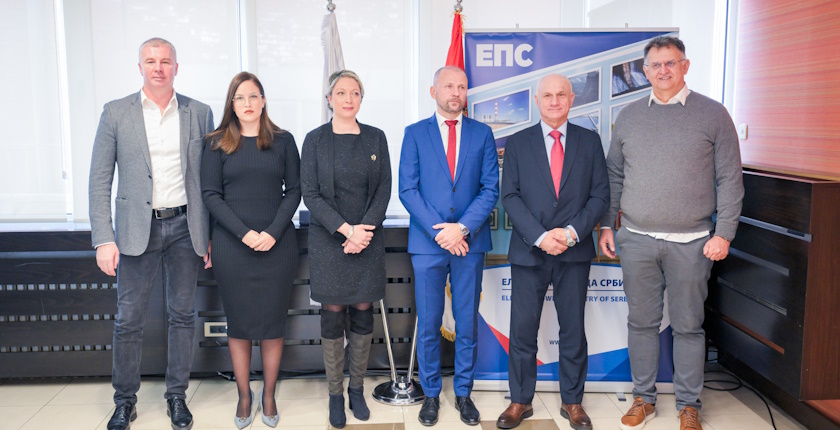
Power utility Elektroprivreda Srbije (EPS) will sell 30 million tons of ash to manufacturers of building materials – the Lafarge Serbia and Elixir Group consortium, and Moravacem.
The consortium of Lafarge Serbia and Elixir Group will buy 20 million tons of ash from thermal power plant Nikola Tesla B (TENT B). Moravacem, a member of the CRH Group, agreed to purchase ten million tons from TE-KO Kostolac, one of EPS’s lignite mining and thermal power plant branches.
EPS said the two contracts are exceptionally significant for introducing circular economy principles in its activities, but also in entire Serbia.
The state-owned company generates up to seven million tons of ash and slag annually in its coal-fired power plants. A small amount is sold, while the rest is disposed of in ash dumps. Lafarge Serbia plans to build a factory near TENT B that would use, as a raw material in its cement production, all the ash generated as a byproduct of combustion.
EPS’s general manager Dušan Živković said the partnership with industrial producers is an example of good practice in improving environmental protection. It also introduces circular economy into business activities.
Živković: Ash is a valuable resource
He added the three companies would invest in ash management and that the equipment would remain in the ownership of EPS.
“EPS generates six to seven million tons of ash per year. Only 5% to 6% is sold on the Serbian market and most is disposed of in the company’s ash and slag dumps. As such, it is categorized as non-hazardous waste,” Živković noted.
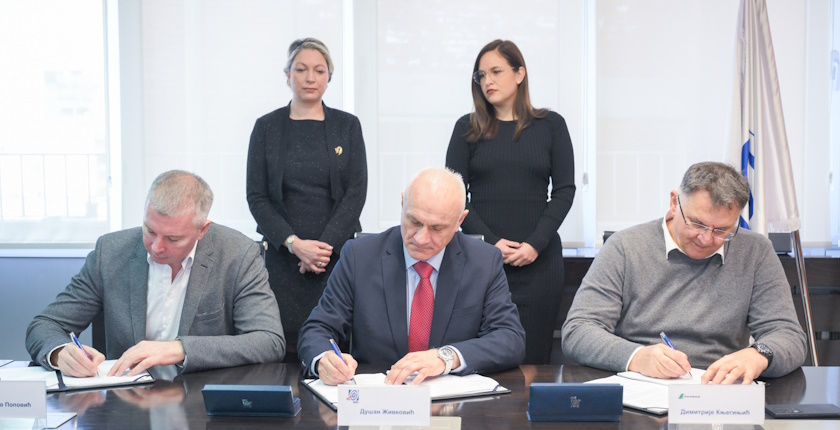
Thanks to new technologies in production, ash can rightfully be considered a valuable resource and there is an opportunity to dispose of it permanently in new construction products, he added.
Knjeginjić: The use of ash as a raw material to reduce the use of natural raw materials is one of the key postulates of circular economy
According to Dimitrije Knjeginjić, Lafarge Sebia’s CEO, it is a strategically important decision of EPS. He argued that synergies of large industrial firms have immeasurable importance not only for the power utility and the disposal of byproducts, but also for the community, in terms of effects on the environment.
In his words, this way EPS will directly reduce the amount of ash that it disposes of in dumps and thus lower the impact on soil, water and air while achieving savings on ash disposal costs.
“The use of ash as a raw material to reduce the exploitation of natural raw materials is one of the key postulates of circular economy. Lafarge Serbia, as a leader in the decarbonization of the industry, will always support such initiatives hoping that together we will build progress for people and the planet in the years to come,” Knjeginjić stressed.
Mauhar: The contract will have a significant positive impact on the environment and the local community
Moravcem’s CEO Siniša Mauhar expressed the belief that the building materials industry is playing a key role in creating a circular economy.
“The materialization of this contract will have a significant positive impact not only on the environment and the local community, but it will also contribute to the creation of additional value for participants in the supply chain,” he stated.
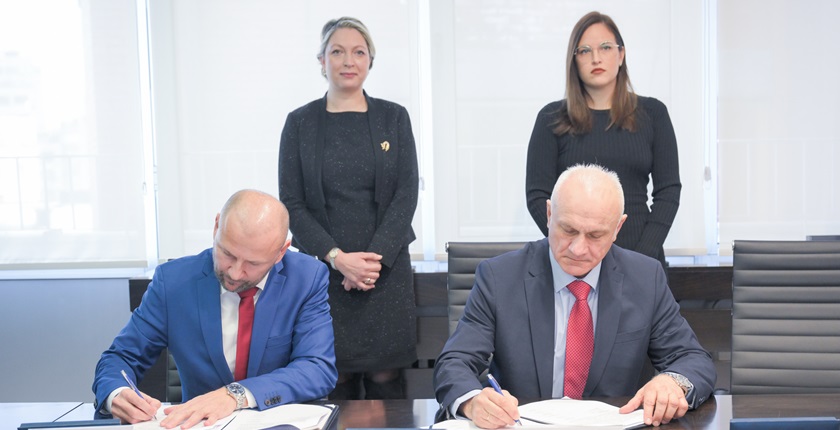
Mauhar pointed out that the strategic partnership with EPS would enable the company to reduce the CO2 footprint of materials that it produces.
EPS said the sale of ash includes requirements such as obtaining a REACH number for ash and building the ash management equipment. The acronym stands for the European Union’s regulation called Registration, Evaluation, Authorisation and Restriction of Chemicals.
The signing was attended by Jovana Joksimović, assistant minister of mining and energy for international cooperation and European integration, and Sara Pavkov, state secretary in the Ministry of Environmental Protection.