


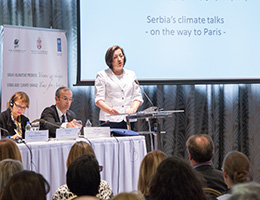
The conference ‘Dialogue on Climate Change in Serbia: Climate-smart Partnerships Ahead of Paris COP21’ was held in Belgrade on October 5 and October 6. The event was organized by the Ministry of Agriculture and Environmental Protection and the United Nations Development Programme (UNDP), with the co-operation of the Embassy of the Republic of France in Serbia and financial support from the Global Environment Facility.
In the opening session, Snežana Bogosavljević Bošković, minister for agriculture and environmental protection, addressed the audience. Irena Vojáčková-Sollorano, UNDP’s resident representative, Michael Davenport, head of the EU Delegation, Axel Dittmann, ambassador of Germany, and Christine Moro, ambassador of France in Serbia, all followed with remarks.
Presentations showed the latest global developments in climate change policy and the preparations for the forthcoming conference in Paris. Regarding COP21, the experts from UNDP and the European Commission’s Climate Change Directorate were able to clarify the main content which will be under negotiation, and the expectations for the new global climate agreement. This agreement should secure further mandatory reduction in greenhouse gas emissions, as well as adaption measures to new climate conditions beyond 2020.
State secretary Stana Božović presented Serbia’s efforts in combating climate change regarding the implementation of international obligations, but also in relation to the harmonization with EU legislation. In addition, particular attention was given to local self-governing authorities and possible measures for initiating innovative development which contributes to the reduction of emissions (so-called low carbon development). Also presented were the views and activities of civil society organizations in this area.
During the second day, the focus of the conference was directed towards examining the scientific facts, data and projections in the field of climate change, as the basis for decision making and planning measures of mitigation and adaptation to changed climate conditions. The participants had the opportunity to get better acquainted with the Global Framework for Climate Services, managed by the World Meteorological Organization.
Publication ‘The Heating Up of Crops – How to Answer’ was presented as a good example of scientifically based recommendations for action. It was prepared as part of ongoing projects of the Ministry of Agriculture and Environmental Protection and UNDP.
Over 200 participants attended the event, ahead of the historical 21st Conference of Parties of the United Nations Framework Convention on Climate Change (UNFCCC), which will be held in Paris from November 30 to December 11. The main slogan of the Belgrade conference was ‘Time for Action’.