


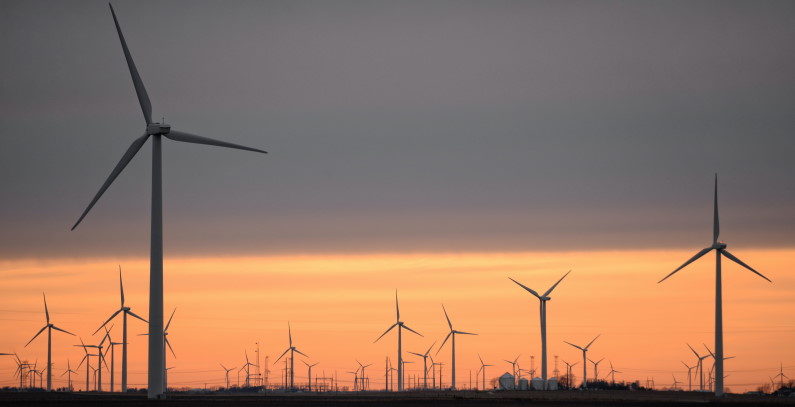
At 632.8 MW, the Maestrale Ring wind power plant in Subotica would now be the biggest in Europe. The city’s local assembly voted for the proposed detailed regulation plan for the area where the subsidiary of Italy’s Fintel Energia intends to build the unit.
The Assembly of the City of Subotica passed the proposed detailed regulation plan for Maestrale Ring, a wind farm project under development by Fintel Energia Group. In its latest financial update, filed with the Belgrade Stock Exchange, the company declared the capacity would be 632.8 MW, compared to 599.2 MW from previous announcements.
Regulated area spans 6,700 hectares
Predrag Radivojević, head of the local Public Enterprise for Road Management, Urban Planning and Housing, said the area included in the document spans 6,700 hectares and that the facility would produce more than 1 TWh of power per year, matching the demand of over 200,000 households. However, he referred to the previous target capacity of almost 600 MW, which may indicate future expansion.
Annual output is seen at more than 1 TWh, a local official says
The manager of the firm controlled by the country’s northernmost city added more than 100 kilometers of dirt roads would be upgraded so that equipment could be hauled to locations of the 113 planned towers. According to earlier information, 75 kilometers were supposed to be covered with a layer of rock. Radivojević estimated 300 to 400 workers would be involved in the construction.
Only Ukraine is developing bigger single-site wind farms in whole of Europe
At 632.8 MW, Subotica would host the largest single-site onshore wind park in Europe at the moment, but there are two bigger ones in the pipeline in Ukraine.
Fintel Energija, the Italian company’s affiliate in Serbia, has a wind power plant portfolio of 993.7 MW in the Balkan country. Košava Phase 1 in Vršac is its largest one already online, at 69 MW. With two other units, the firm operates 85.5 MW.
According to the said semiannual report from August, wind parks Košava Phase 2 (65.5 MW) and Ram (10 MW) were under construction. Five units of 10 MW each were in late stages of development.
Torak in Sombor, with an envisaged capacity of 140 MW, was under development together with the Subotica megaproject and the 9.9 MW Košava 2 wind park. All the locations are in Serbia’s northern part.