







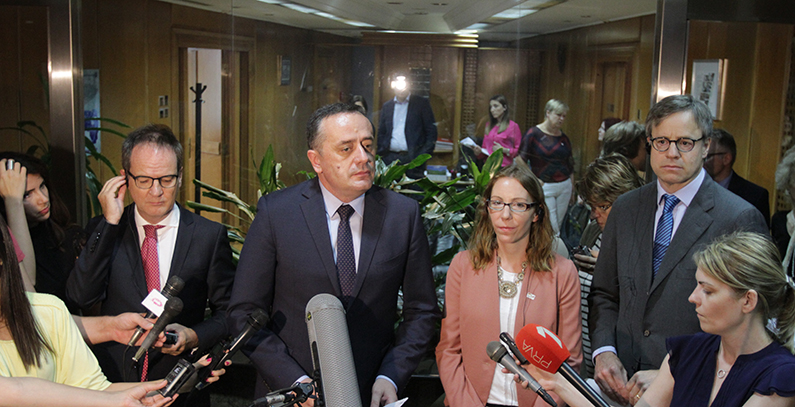
Photo: Ministry of Mining and Energy


Serbia will receive funds from the German development bank KfW and the Swiss government to convert 10 heating plants from fossil fuels to biomass. The five agreements on the loans and grants was signed by Serbian Minister of Mining and Energy Aleksandar Antić and German and Swiss representatives.
The project is worth a total of EUR 27 million, which apart from the loan includes a EUR 2 million grant from the KfW while the government of Switzerland will secure a grant of EUR 5 million.
The agreements on financing conversion of district heating companies from fossil fuel to biomass based are part of the project Stimulating Renewable Energy – the Development of the Biomass Market in Serbia (DKTI) which was launched in Serbia back in 2012 with a feasibility study for Subotica district heating company. The signing of the agreement marked the start of first stage of that project, with total value of EUR 108 million, where EUR 8 million goes to the technical assistance of GIZ.
Speaking after the signing ceremony, Minister Antić said that the loan was approved under very favorable conditions which include a low interest rate of 1.1%, a five year grace period and a 10 year deadline for the municipalities which get the loans to repay the money.
He said the project goal is to convert as many heating plants as possible from fossil fuels to biomass or other renewable energy sources. The first stage will cover heating plants in the municipalities of Mali Zvornik, Nova Varoš, Novi Pazar, Prijepolje, Bajina Bašta, Valjevo, Priboj, Kladovo and Majdanpek”, Antić said adding that the municipality of Bečej has started two projects – one to convert a part of its heating plant to biomass and the other aimed at using geothermal energy.
German ambassador to Serbia Axel Dittman said the project is important under Chapter 27 of the pre-accession negotiations on membership in the European Union, adding that the conversion to renewable energy sources also lowers carbon dioxide emissions and helps protect the environment.


Be the first one to comment on this article.