






Photo: Pexels


Expanding the EU’s electricity grid infrastructure and implementing measures to increase demand flexibility could bring down power prices significantly, according to a report by Allianz Research. However, this would require massive investments in grid infrastructure and doubling interconnector and storage capacity by 2030.
Due to delays in grid expansion, over 800 GW of wind and solar capacity are still awaiting connection, nearly double the current supply, while high electricity prices are undermining industrial competitiveness and burdening consumers. Without urgent grid investments and modernization, the EU could fail to meet its 2050 net-zero target, which requires intermittent renewables to account for 82% of the bloc’s electricity supply, according to the report.
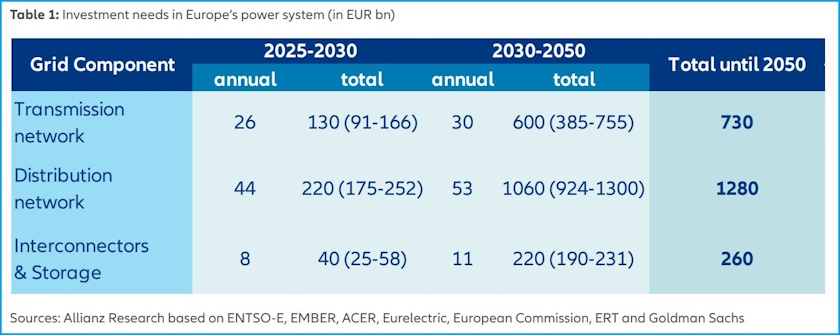
In a net-zero scenario, transforming the EU’s power sector to a climate-friendly system could lower final power prices by 11% as soon as 2035 and by 30% in 2040, according to the report. This, however, would require EUR 2.3 trillion in grid infrastructure investments by 2050, or EUR 90.8 billion a year on average.
The lack of grid flexibility exacerbates intraday price volatility, with high electricity prices during peak demand and negative prices during off-peak hours. In Germany alone, compensation for renewables reached EUR 20.9 billion in 2024. Grid congestion costs are still lower (EUR2.5bn in 2019) but are projected to surge to EUR 12.3 billion by 2030 and EUR 56.7 billion by 2040 without upgrades.
These costs ultimately impact electricity prices, the report reads.
Of the total investment, 56% would go towards distribution network
Of the total investment, 56% would go towards distribution network expansion, which requires EUR 220 billion by 2030. Germany, France, and Italy would account for 50% of the spending.
Transmission infrastructure, which is set to expand by 28% by 2030, would soak EUR 694 billion by 2050, while interconnector and storage capacity, which needs to double by 2030, would add a further EUR 10 billion in investment annually.
Smart meters and electric cars could help boost flexibility and lower investments
To reduce grid investment costs and enhance efficiency, Europe needs to make electricity demand more flexible, the report underlines.
Measures that could help improve flexibility include increasing the use of smart meters, which would reduce peak loads and storage needs while lowering household energy consumption by 2-10% percent.
Power-to-X technologies can utilize surplus renewable electricity
Power-to-X technologies can utilize surplus renewable electricity to power downstream industries. In Germany alone, the 10 TWh of curtailed renewables in 2023 could have been used to produce green hydrogen, covering 12% of national demand without additional generation, according to the report.
Other measures include promoting electric vehicles (EVs) with bi-directional charging. Their batteries can serve as storage in the grid, improving stability and reducing congestion while cutting EU emissions by 7%.
Also, aligning electricity pricing zones with grid conditions would lower congestion costs and improve renewables integration, ensuring a more flexible and cost-efficient energy transition, according to the report.

Be the first one to comment on this article.