


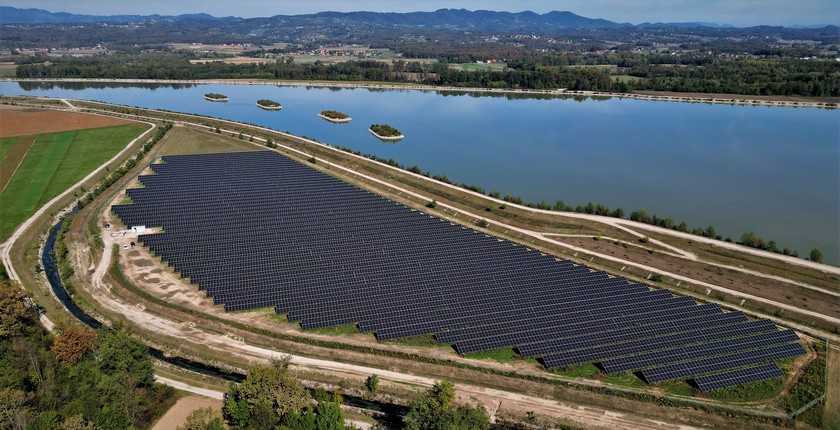
Hydropower plant operator Hidroelektrarne na spodnji Savi (HESS) has officially opened Slovenia’s biggest solar power plant, with an installed capacity of 6 MW. Together with the Brežice hydropower plant, it makes a hybrid system. At the same time, Brežice’s water reservoir will provide energy storage.
Spanning an area of six hectares, the Brežice solar power plant consists of about 13,200 photovoltaic panels, and will be able to produce 6.84 GWh of electricity a year, enough to meet the needs of some 1,800 households. Its projected lifespan is 30 years.
The facility, representing a fourth unit of the Brežice hydropower plant, is also the only solar power plant in Slovenia connected to the 110 kV transmission grid, according to HESS CEO Bogdan Barbič.
The hydropower plant’s water reservoir will provide energy storage
The flow-through water reservoir of the Brežice hydropower plant will provide energy storage for balancing the solar power plant’s variable output, according to him. A hybrid system is about connecting different renewable energy sources and at the same time using them in the most efficient way, Barbič said at the opening.
HESS invested EUR 5.5 million in the construction of the solar power plant, with EUR 750,000 provided by Slovenia’s public environmental fund Eco Fund. The project was launched in August 2021 and the installation started in May 2022. The plant was tested in December, and HESS received the operating permit for it earlier this month.
Slovenia has big plans for large-scale solar power plants
According to Minister of the Environment, Climate and Energy Bojan Kumer, who attended the ceremony, Slovenia has big plans when it comes to solar energy. The Brežice project, he said, represents “about one hundredth” of what the country intends to do with regard to large-scale solar power plants over the next ten years.
Slovenia readies regulation to speed up renewables projects
Kumer also announced a new regulation that will help speed up the use of renewable energy sources and innovative technologies in that field.
Earlier this year, Austria-based Enery secured local authorities’ support to install a 7.5 MW solar power plant on an empty lot within a highway junction in the Slovenian municipality of Divača.
Last September, state-owned hydropower plant operator Dravske elektrarne Maribor put into operation the first, 2.5 MW portion of its Zlatoličje-Formin solar power plant, whose total installed capacity will be 30 MW.