






Photo: PIRO4D from Pixabay


Nonprofits can apply for up to EUR 1 million from the European Climate Initiative (EUKI) with transformative cross-border projects that help climate change mitigation. The call is open for potential beneficiaries in EU member states and candidate countries.
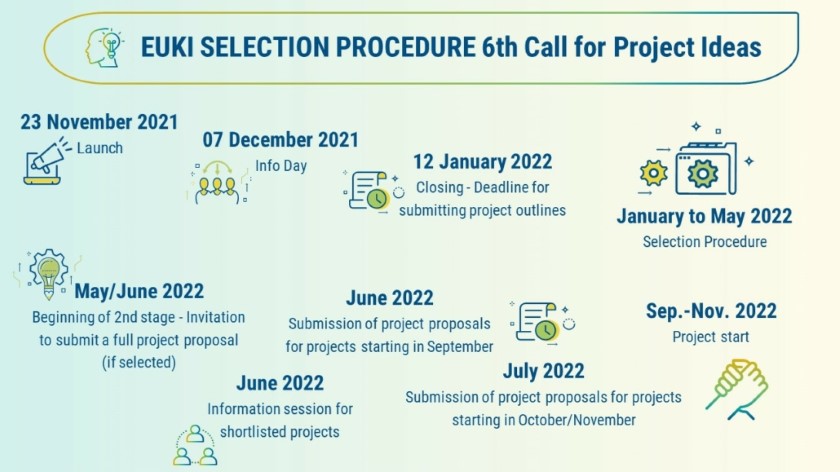
Civil society organizations, academic and educational institutions, governments, municipalities and non-profit enterprises such as think tanks have until January 12 to submit concept notes to the European Climate Initiative in its sixth call. The program is financing creative ideas for a climate-neutral Europe.
Interested entities should find suitable partners and sketch ambitious proposals together. It needs to fit into one of the core areas: climate policy, energy, buildings and municipalities, mobility, agriculture, soils and forestry, awareness, climate-aligned finance and sustainable economy.
EUKI mostly supports cross-border projects on a national, regional or local level
The beneficiaries are entitled to between EUR 120,000 and EUR 1 million per project. The recipe is to make it feasible for making a contribution to climate change mitigation. Most projects in the EUKI program are implemented across borders on a national, regional or local level.
Program is open for entities in EU candidate countries
For instance, Young Energy Europe 2.0 trains mainly young professionals in Bulgaria, Croatia, the Czech Republic, Greece, Hungary, Poland, Serbia and Slovakia to qualify as energy scouts. They come from a wide range of industries. Energy scouts learn to analyze energy consumption in their company and to collaboratively develop practical projects to reduce energy and resource consumption.
Within the Regions and Municipalities for a Just Transition project, which ended last year, comprehensive plans for socioeconomic structural change were developed for the coal regions of Southwest Bulgaria and Silesia in Poland.
EUKI supports climate projects in European Union member states, with a regional focus on Central, Eastern, Southern Europe and the Baltic states. Implementers from candidate countries – Turkey, North Macedonia, Montenegro, Albania and Serbia – may participate or measures may be financed if the lead implementer is from an EU member state.
The program began in 2017. So far it funded 157 projects by 308 organizations.
Info Day will be held on December 7
The eligible objectives are capacity development, creation of networks, implementing policies and measures, and dialogue formats and dissemination. The applications are submitted via an online tool. The selected organizations will have six weeks to submit a full project proposal. The first projects are scheduled for launch in September.
Anyone interested can join the virtual EUKI Info Day on December 7 and learn more about funding objectives, formal requirements and the evaluation procedure.
EUKI is implemented by Deutsche Gesellschaft für Internationale Zusammenarbeit (GIZ) on behalf of the German Federal Ministry for the Environment, Nature Conservation and Nuclear Safety (BMU).
*This article was co-developed by the European Climate Initiative – EUKI.




Be the first one to comment on this article.