






Photo: European Union /Aurore Martignoni


The European Commission presented the European Grids Package, a comprehensive plan to modernise transmission infrastructure, accelerate permitting procedures, and overcome bottlenecks in Europe’s electricity networks. It also unveiled the Energy Highways initiative, which consists of eight major infrastructure projects critical for energy security, renewable energy integration, and cross-border electricity market connectivity.
Energy infrastructure is the backbone of the energy system. Yet the EU’s energy network remains insufficiently integrated, and investment levels fall short of what is needed, a situation that directly affects household energy bills.
Ageing infrastructure and limited interconnection capacity are creating bottlenecks that slow the energy transition. Although some progress has been made within the existing EU legislative framework, the level of interconnection among member states remains inadequate. Several countries are not on track to meet the 15% interconnection target by 2030.
To address these challenges, the European Commission has presented the European Grids Package and Energy Highways initiative. The aim is to enable a more efficient flow of energy across the EU, integrate greater volumes of renewable energy into the system, and accelerate electrification.
Jørgensen: A truly interconnected energy system is the foundation of a strong and independent Europe
The Grids Package is designed to speed up permitting and ensure a fairer distribution of costs for cross-border infrastructure. It should also improve the use of existing infrastructure and accelerate the development of networks and other physical energy assets across the EU.
Among the measures is a new mechanism that allows the commission to initiate the search for additional infrastructure projects when existing initiatives do not cover identified cross-border needs.
“A truly interconnected and integrated energy system is the foundation of a strong and independent Europe. To achieve it, we need an energy infrastructure network of cables, pipes and grids that is up to date, fully interconnected, and that enables clean, affordable, homegrown energy to flow freely and securely to every corner of our union. This is exactly what we are proposing today: a common European energy project that supports affordable living, economic competitiveness, security, and decarbonisation,” said Dan Jørgensen, European Commissioner for Energy and Housing.
Permitting reform
Slow permitting remains one of the biggest bottlenecks for energy infrastructure and renewable energy projects in the EU.
Obtaining permits for transmission infrastructure currently takes more than five years on average, while renewable energy projects may face delays of up to nine years.
The Grids Package introduces simplified and accelerated permitting procedures. The commissioners have proposed setting time limits within which decisions must be taken for all types of projects. If the competent authority fails to respond within the deadline, the permit would be considered granted.
Permits for smaller projects would be issued through faster and more streamlined procedures
Permits for smaller projects would be issued through faster and more streamlined procedures. All processes would have to be fully digitalised, and national administrations would be required to have adequate staffing and technical capacity to process applications.
The commission is proposing to move away from the current first-come, first-served model and introduce a system that ensures timely and non-discriminatory access to the grid, one that balances social acceptance and industrial competitiveness.
Public and private financing
According to the commission’s estimates, EUR 1.2 trillion in investment will be needed for Europe’s electricity grid by 2040. Distribution networks account for EUR 730 billion within the sum, compared to EUR 240 billion for hydrogen infrastructure.
The commission said additional financing tools are required, including cost-sharing arrangements, arguing that cross-border infrastructure generates benefits that extend beyond the territory in which a project is located.
Another suggested solution is the formation of project firms (special purpose vehicles – SPVs) to attract additional private investment.
Given that grid infrastructure is largely financed through network tariffs, part of the burden falls on consumers. To ease this pressure, the commission announced it would boost financial support through the Multiannual Financial Framework (MFF), the EU’s regular seven-year budget, including a significant expansion of the Connecting Europe Facility (CEF). The tool is designed to support investments in new cross-border energy infrastructure and upgrades or rehabilitation of existing assets.
The current 2021–2027 EU budget contained EUR 5.8 billion for cross-border projects under CEF. For the 2028–2034 period, the commission said the amount would be raised almost fivefold, to EUR 29.91 billion.
On the private side, the EU is working on its Clean Energy Investment Strategy, to launch it in 2026 by outlining measures for private sector participation including institutional investors, as well as additional support from the European Investment Bank (EIB).
Energy Highways
The Energy Highways initiative comprises eight of the EU’s largest and most critical infrastructure projects, essential for energy security, renewable energy integration, and cross-border electricity market connectivity.
They have already been already listed as Projects of Common Interest (PCI) or Projects of Mutual Interest (PMI), but under the new initiative, they would receive elevated political priority, accelerated financing, and faster permitting.
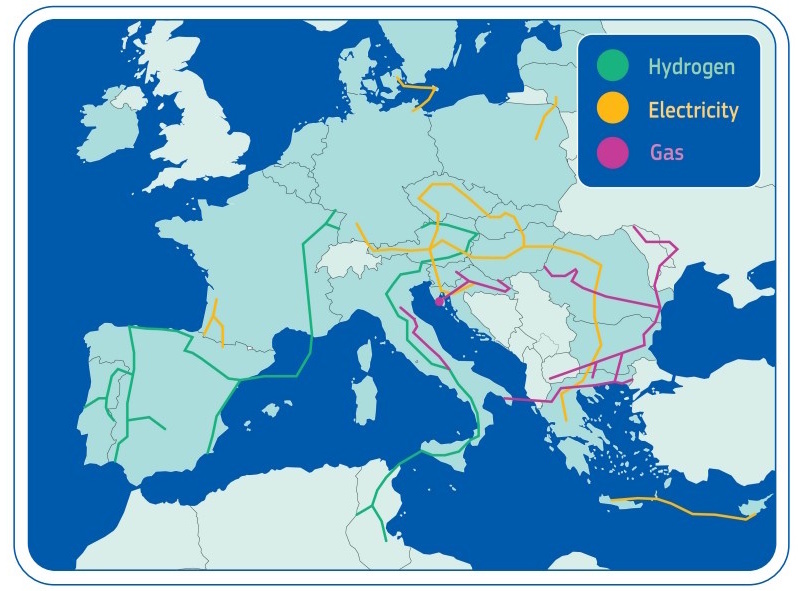
Among the projects are the reinforcement of interconnections across the Pyrenees to improve the integration of the Iberian Peninsula, the connection of Cyprus with continental Europe through the Great Sea Interconnector, as well as an upgrade of electricity links between the Baltic states, including the Harmony Link to Poland, which is essential for the full synchronisation of the region with the European grid.
The commission has also endorsed the establishment of Denmark’s hub on the island of Bornholm, which could, in the coming years, be connected to additional locations in the Baltic Sea.
Among the priorities are strengthening energy storage capacity in South-Eastern Europe
Among the priorities are strengthening energy storage capacity in South-Eastern Europe, as well as the modernisation of the Trans-Balkan Pipeline (TBP) for gas.
The list includes two hydrogen corridors. The southern one would connect Tunisia, Italy, Austria, and Germany, and the south-western corridor is a planned link between Portugal, Spain, France, and Germany. The commission has announced strong coordination and political support for the latter.
The commission views these projects as pillars of Europe’s future energy network, essential for lower electricity prices, greater system stability, and reduced dependence on fossil fuels.
In a regular legislative procedure, the proposals now move to the European Parliament and the Council of the EU for further deliberation.




Be the first one to comment on this article.