






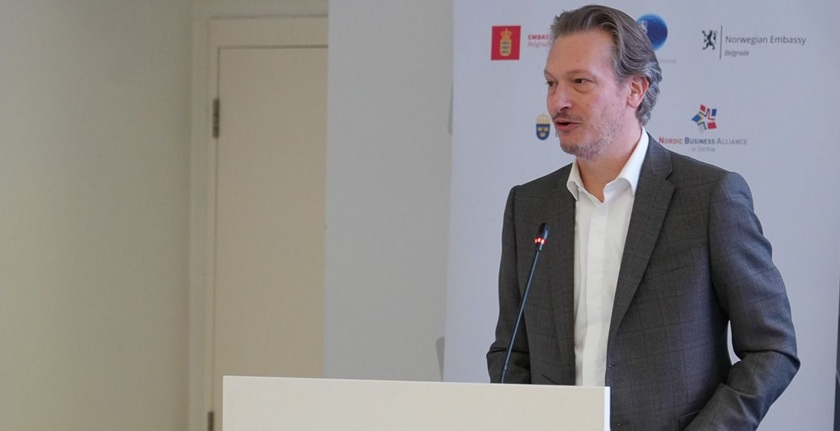
Mihailo Vesović (photo: PKS/LinkedIn)


The energy transition is crucial for the competitiveness of the economy, but also the survival and entry of Serbia into the European Union, according to Deputy President of the Serbian Chamber of Commerce and Industry (PKS) Mihailo Vesović.
At the panel Decarbonizing Competitiveness: How CBAM and Related Methods Shape the Future of Serbian Industry, at the 33rd Kopaonik Business Forum, Mihailo Vesović pointed out that 11.5% of the value of domestic exports to the European Union consists of products subject to the Carbon Border Adjustment Mechanism (CBAM).
More than 70% of Serbia’s total exports go to the EU and the region, he added, news agency Tanjug reported. PKS republished the article.
With CBAM, the EU aims to accelerate the adjustment of the Serbian economy to its standards
The EU’s CBAM entered into force on January 1. Firms in the EU that import aluminum, cement, electricity, iron and steel, hydrogen and fertilizers from non-EU countries are obliged to pay a carbon price under the scheme.
Vesović stressed that CBAM is a tool the EU is using to accelerate and pressure the adjustment of the Serbian economy to EU standards.
The important thing is that CBAM is becoming a reality for Serbia this year, even though payments begin next year, he added.
Of note, the deadline to submit CBAM certificates for 2026 is May 31, 2027.
It is necessary to accelerate the energy transition
“The energy transition is not just a question of competitiveness of the domestic economy, but also a question of survival and the speed of EU accession,” Vesović underscored.
He noted that although Serbia is a signatory to the Paris Agreement, it is lagging behind the rest of Europe in terms of the speed of adaptation and the fulfillment of its obligations.
“It is necessary to accelerate the transition, because it will cost us. It will cost us primarily economically, and it will also cost us by slowing down European integration,” the Deputy President asserted.
Lazarević: We expect domestic taxes to be recognized in the EU
Strahinja Lazarević, Strategic Planning Manager at Elixir Group, explained that regarding competitiveness, it is not important how high the CBAM tax is for the company itself, but whether it is higher or lower than for the competition.
Elixir Group’s expectation regarding domestic taxes is that they are recognized in the EU and that they don’t complicate the administrative process of proving what has already been paid. He referred to the greenhouse gas emissions tax and carbon-intensive product imports tax. Serbia introduced them on January 1 as a response to CBAM.
The chemicals company is subject to them with its production, but also when importing raw materials such as ammonia, Lazarević added.
It is a complex mechanism that will need to be tested for several years, in his view. For Elixir, this is an initial system setup, which will lead to full alignment with the EU in later years, he stressed.


Be the first one to comment on this article.