


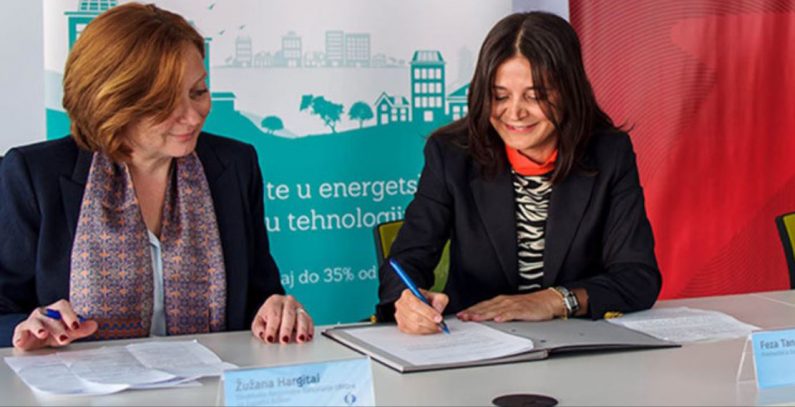
The EBRD is providing a loan of up to RSD 600 million (equivalent to EUR 5.1 million) to UniCredit, the second-largest bank in Serbia, to enhance its financing of the green economy, according to a news release from the EBRD.
The loan comes under the EBRD’s EUR 85 million Green Economy Financing Facility for the Western Balkans, implemented in partnership with the Secretariat of the Energy Community. The initiative is designed to help local households, housing associations and service providers invest in energy efficiency measures and renewable energy projects.
Incentives and technical cooperation in support of green technology investments will be provided by the European Union, the Austrian Federal Ministry of Finance and the European Western Balkans Joint Fund under the Western Balkans Investment Framework.
The funds will be on-lent for investments in high-performance energy efficiency technologies, materials and solutions in residential buildings, for example to replace windows or doors, retrofit façades, procure heating equipment or thermal insulation material, photovoltaic panels, heat pumps, and other measures. The goal is to reduce energy intensity and improve energy efficiency in accordance with the EBRD’s Green Economy Transition (GET) approach. With these investments households will not only become more energy efficient but will also decrease their greenhouse gas emissions, reducing their impact on the environment.
UniCredit Bank will approve consumer loans of up to RSD 3 million on a repayment period of up to seven years. The incentive is up to 20% of the investment. The nominal interest rate is 9.11% annually, while the effective interest rate is 10.82% annually.
“We are pleased to further our cooperation with our long-standing partner, UniCredit, by offering a green financing line. Not only will it help Serbian families cut energy bills and reduce emissions, but it is also our first project with UniCredit which will provide loans in local currency,” said EBRD Director for Western Balkans Zsuzsanna Hargitai.
The EBRD is a leading institutional investor in Serbia. To date it has committed EUR 982 million to almost 60 green projects across the country. In 2017 alone the Bank provided over EUR 380 million to more than 200 projects across various sectors of the Serbian economy.