





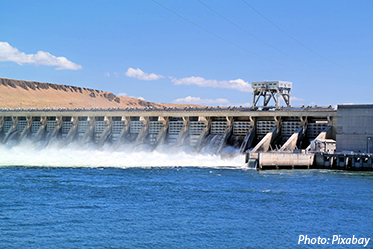


The European Bank for Reconstruction and Development (EBRD) said it is considering providing a senior secured loan of up to USD 45 million (EUR 40.1 million) to special purpose vehicle Kremna Enerji ve Ticaret AŞ, fully owned by Gama Enerji AŞ (GEAS), for the acquisition of hydropower plants (HPPs) Karacaören 1 and Karacaören 2 located in Burdur, Turkey, from the national Privatization Administration (ÖIB). The overall project is worth EUR 169.3 million and target board date for final review is May 25.
Gama was the winning bidder at the tender held on November 9 for the facilities, which have been operational for the last 23 years. The privatization is in the form of transfer of operating rights for 49 years. The loan is part of a wider financing package alongside the International Finance Corporation and the Industrial and Commercial Bank of China (ICBC).
EBRD said it supports the ongoing liberalization of the country’s electricity generation market by backing one of the committed private energy players through financing the privatization of the HEPPs. Another objective, according to the press release, is to low carbon transition through the modernization of a renewable asset. “A reliable baseload and flexible peaking plant… is required to accommodate the growth in intermittent renewables generation, in line with the strategy of the Turkish government of strengthening security of supply and enhancing use of local energy sources and diversifying away from expensive imported fuel sources,” the statement adds.
The project will contribute to increasing the share of privately-owned generation capacity in Turkey where 32% of installed capacity remains state-owned, EBRD said. The HPPs will operate on a fully merchant basis, trading most of the output on the spot market. The project also has the potential for the development of operational and technical efficiency, according to the lender.
Gama is a power and water company headquartered in Turkey with operational assets in the home market and Jordan. It owns and operates a portfolio of 260 MW of power generation assets in Turkey and also owns the build-operate-transfer (BOT) Disi Water supply project in Jordan with a conveyance capacity of 100 million cubic metres per year. Furthermore, the company has a 840 MW natural gas–fired plant and a 43 MW wind power plant under construction.
Gama Enerji is owned 50.5% by Gama Holding AŞ, 30% by Tenaga Nasional of Malaysia, 14.5% by IFC and 5% by AMC Global Infrastructure Fund. An environmental and social due diligence (ESDD) of the HPPs was carried out for risks and liabilities associated with the construction and operation. The project is associated with environmental and social risks that are site specific and can be readily mitigated, EBRD claims. An environmental and social action plan (ESAP) was agreed with Gama for EBRD’s performance requirements. ESAP’s main actions are related to human resources management, stakeholder engagement, corporate social responsibility, public safety risks, environmental management and health and safety, the bank said.