


The Croatian Meteorological and Hydrological Service has introduced a regular air quality forecast for the current and following two days to help citizens protect their health.
Air pollution is a major issue for the countries in Southeast Europe such as Slovenia, Croatia, Bosnia and Herzegovina, Serbia, Romania, Bulgaria and North Macedonia.
Croatian Meteorological and Hydrological Service (DHMZ) said the three-day air quality forecast for Croatia is publicly available on its website.
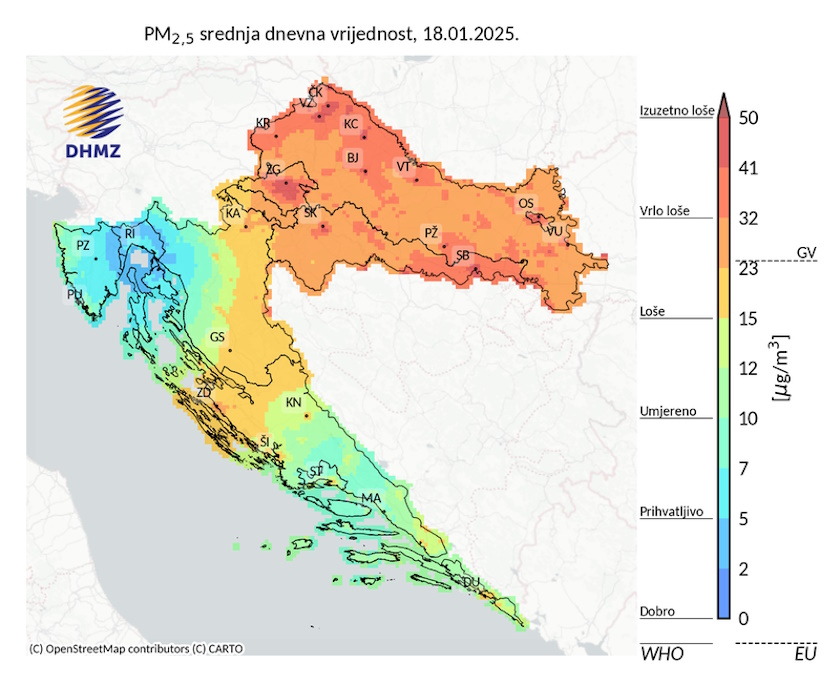
The new tool provides useful information on air quality and enables citizens to plan outdoor activities and make better decisions about health protection.
The forecast displays values of four key air pollutants that contribute immensely to public health: particulate matter PM2.5 and PM10, nitrogen dioxide (NO2), and ground-level ozone (O3).
Air quality categories are ranked in line with the World Health Organization’s standard and its respective recommendations are listed
The values are calculated from the forecasted concentrations for a certain day, for which the mean daily concentration for PM2.5, PM10, and NO2, and maximum daily eight-hour O3 values are calculated. Air quality levels are shown on a color scale and range from good to extremely poor.
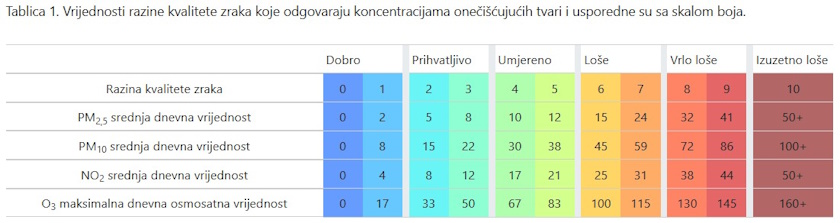
The overall level of air quality is marked from zero to ten. Zero and 1 are defined as good, grades 2 and 3 are acceptable, moderate is from notch 4, while 6 and 7 are bad, 8 and 9 are defined as very bad and 10 is extremely bad. Each level is accompanied by the recommendations of the World Health Organization (WHO) for the general population and more sensitive groups – for example, children and adults with respiratory problems.
DHMZ said the forecasts are updated daily.
The three-day air quality forecast is derived from the ATMOSYS (LIFE+) air modeling system, adapted for Croatia within the European Union’s project AIRQ – Expansion and Modernisation of the National Network for Continuous Air Quality Monitoring.
The initiative represents an important step in protecting the health of Croatia’s citizens, meeting EU standards, and strengthening transparency with timely data on air pollution, according to DHMZ.
Güttler: The service was designed by using artificial intelligence, machine learning algorithms
General manager Ivan Güttler said the methodology basis was largely developed using artificial intelligence (AI) and machine learning (ML) algorithms.
“The Destination Earth project, aimed at developing meteorological models by applying an AI/ML algorithm, and the ATMOSYS prognostic system, which uses the same technologies for air quality forecasting, position DHMZ on the European map of national hydrometeorological services in which AI/ML are switching from the prototype phase to operational implementation,” he asserted.
According to Jadranka Škevin-Sović, head of the air quality sector in DHMZ and of AIRQ, the air quality forecast is one of the key results of the said project.
It was funded 85% from the EU while the remainded was provided from national sources, she said.
Brzoja: Inland areas are under strong pressure from pollutant emissions from small furnaces for household heating
Among the expected results is the reduction in the number of illnesses and premature deaths caused by air pollution and a decrease in treatment expenses, according to Škevin-Sović.
Darijo Brzoja, head of the air quality modeling, research, and application department within DHMZ’s air quality sector, said that in Croatia air is better in the Adriatic and coastal areas, where wind continuously blows away the harmful particles.
Conversely, inland areas are under strong pressure in the winter from emissions from small furnaces for household heating. In combination with unfavorable meteorological conditions and the absence of wind, pollution accumulates close to the ground, where people inhale it, Brzoja stressed.