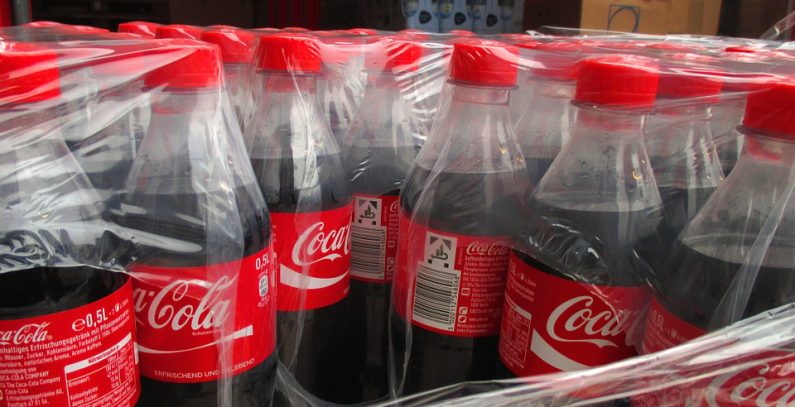
Coca-Cola has revealed for the first time it produces 3 million tonnes of plastic packaging a year – equivalent to 200,000 bottles a minute, The Guardian has reported.
The data from the soft drinks giant was provided to the campaigner Ellen MacArthur, who is pushing for major companies and governments to do more to tackle plastic pollution, The Guardian wrote.
The figures – which the company has refused in the past to disclose – reveal the amount of plastic packaging Coca-Cola produced in 2017. The company did not reveal the scale of its bottle production but when its packaging footprint is translated into 500ml PET plastic bottles, it amounts to about 108 billion bottles a year, more than a fifth of the world’s PET bottle output of about 500 billion bottles a year, the report reads.
Coca-Cola is one of 31 companies – including Mars, Nestlé and Danone – that have revealed how much plastic packaging they create as part of a drive for transparency by the Ellen MacArthur Foundation, a charity that works with business and education to accelerate the transition to a circular economy. Combined, they produce 8 million tonnes of plastic packaging a year.
But the majority of the 150 companies who have signed up to MacArthur’s global commitment to reduce plastic pollution are still refusing to publicly disclose figures on their own plastic packaging production. These include Pepsi Co, H&M, L’Oréal, Walmart, Marks & Spencer and Burberry – which was heavily criticized last year when it was revealed that the company burned GBP 28 million of stock in a year to prevent counterfeiting.

A total of 150 companies have signed up to the foundation’s global commitment to reduce plastic waste, which aims to:
- Eliminate unnecessary plastic packaging and move from single-use to reusable packaging.
- Innovate to ensure 100% of plastic packaging can be easily and safely reused, recycled, or composted by 2025.
- Create a circular economy in plastic by significantly increasing the volumes of plastic reused or recycled into new packaging.
A first step by many of the companies who have signed the commitment was more transparency. Alongside Coca-Cola’s data, Nestlé revealed it puts out 1.7 million tonnes of plastic packaging annually, Unilever 610,000 tonnes, and Danone 750,000 tonnes.
Only two global raw material plastic producers have signed the commitment – Indorama and Borealis – and no airlines, food chains or hotels, The Guardian wrote.
According to a study published in 2015 in the journal Science, an estimated 8 million tonnes of plastic waste end up in oceans every year, and the quantity could multiply tenfold in the business-as-usual scenario.