







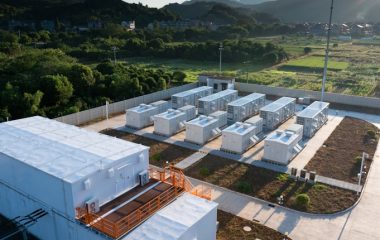
Nanjing, Jiangsu Province, China (Photo: chenyongdx from Pixabay)


The world’s largest compressed-air energy storage plant, with a capacity of 2.4 GWh, has come online in China’s Jiangsu province. The facility stores energy in underground salt caverns without burning fuel.
The compressed-air energy storage (CAES) facility consists of two 300 MW non-combustion energy storage units. It operates by compressing air and injecting it into underground salt caverns during periods of low electricity demand. The stored air is then released to power air turbines and generate electricity during peak demand hours.
The CAES system uses molten salt and pressurized thermal water for heat management
The system employs molten salt and pressurized thermal water storage for heat management, achieving 71% conversion efficiency, according to Harbin Electric Corporation, which supplied the equipment for the Guoxin Suyan Huai’an Salt Cavern Compressed Air Energy Storage Demonstration Project.
The first 300 MW unit reached full-load operation in December 2025, and the second one was switched on earlier this week, according to reports. The total investment in the project is valued at USD 520 million, and the facility is expected to generate 792 GWh of electricity annually.
China plans USD 35 billion in investment to boost storage capacity by 2027
The project increased China’s long-duration energy storage capacity, supporting its ambition to boost its total energy storage capacity, not including pumped hydropower, from over 100 GW in 2025 to more than 180 GW by 2027. The target was announced in September 2025 in an action plan that is expected to mobilize more than USD 35 billion in investment over three years, according to earlier reports.
Battery energy storage is a key part of China’s green transition strategy, along with solar and electric vehicles.


Be the first one to comment on this article.