






Photo: Sebastian Burduja / Facebook


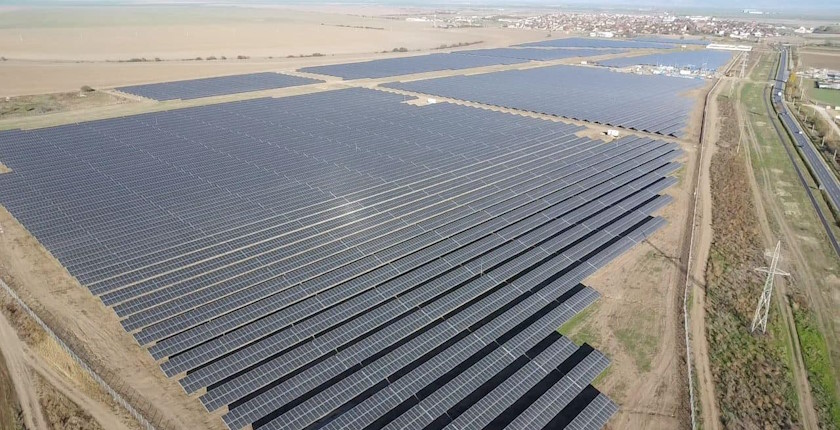
Austria-based CCE Holding finished the installation of a photovoltaic facility in Arad county in Romania in less than a year. The solar power plant of 40 MW in peak capacity spans 50 hectares.
A few years ago, photovoltaic projects kept piling up in Romania, together with companies’ ambitions and pledges, but with little activity on the ground. Fast forward and the country is enjoying a genuine solar power boom. The Ministry of Energy has highlighted a new facility, built by CEE, and said it would try to inaugurate one project per week.
The solar park of 40 MW in peak capacity is in Vladimirescu commune in Arad county in Romania’s northwest. Clean Capital Energy (CCE) Holding is a PV project developer based in Vienna, Austria.
The Horia or Horia1 facility is its first in Romania. The solar power plant spans 50 hectares. Minister Sebastian Burduja said the investment is worth more than EUR 35 million.
Horia project was one of first in Romania to obtain NRRP funding
Annual output is expected to be equivalent to power consumption of 17,000 Romanian households, according to the update. Construction started in late December.
CCE has developed the project in cooperation with Banat Agri Group and Austria-based Frapag. It obtained EUR 3 million from the Romania’s National Recovery and Resilience Plan (NRRP or, in Romanian, PNRR). The company won support in the first round of applications.
Mayor of Vladimirescu Mihai Mag valued the investment at 40 million euros and said the project would have two more phases.
CCE has solar power projects in Romania underway for 1.3 GW in peak capacity
The PV park in Vladimirescu consists of solar modules of 590 W. CCE Holding earlier revealed that it secured financing from Raiffeisen Bank International.
In Romania, the company has photovoltaic projects for 1.3 GW in peak capacity under development, of which it plans to install 220 MW within two years.
CCE also operates in Italy, France, the Netherlands, Germany and Chile, with a total of 2 GW in peak capacity underway. Except for large ground-mounted solar power units, it works on commercial rooftop PV systems and energy storage.
With each new megawatt put into operation, Romanians’ bills will decrease, Romanian companies will be more competitive, and Romania’s energy will be safer, more accessible and greener, Burduja said. He noted that his ministry has obtained a total of EUR 13 billion in grants for energy projects.
Be the first one to comment on this article.