


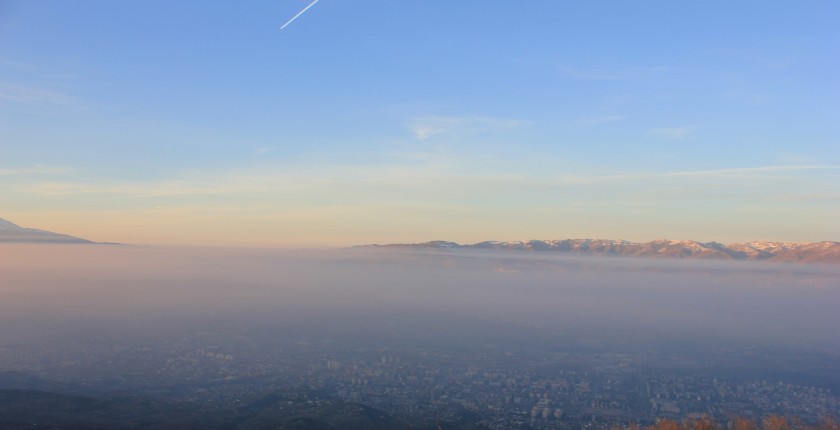
The Government of North Macedonia introduced emergency measures and issued recommendations to reduce air pollution and protect the population in the capital Skopje and four other cities. Healthcare facilities are on high alert while employers were asked to allow pregnant women, workers over 60 and those with serious medical issues to abstain from work.
The concentration of particulate matter of the PM10 type has surpassed 150 micrograms per cubic meter in the air at several measuring stations for two days in a row, triggering an alert in five cities in line with a protocol that North Macedonia adopted in 2017. The government issued recommendations for the protection of the population and said it intensified the monitoring of pollutant emissions.
The Balkans suffer from some of the world’s worst rates of air, water and soil pollution. Still, North Macedonia does stand out, alongside a few other local examples in the region, with its alarm system for air pollution and long-term efforts to improve air quality, and it achieved some progress.
Alarms were first declared in the capital city of Skopje, Kičevo, Kavadarci and Strumica, and the city of Gostivar followed. The government pointed out that the data for Tetovo and Gevgelija are temporarily unavailable. The public alert threshold was set at 200 micrograms per cubic meter in 2017, but the authorities gradually lowered it in the meantime.
The public alert threshold was set at 200 micrograms per cubic meter in 2017, but the authorities gradually lowered it in the meantime
The cabinet asked all employers to allow pregnant women, people older than 60, asthma patients and those with a history of heart attacks and strokes to abstain from work if their doctors recommend so. Persons responsible for outside activities should work only from 11:00 until 17:00.
There shouldn’t be any public events in the open, while emergency healthcare facilities must increase the level of preparedness. The Ministry of Labour and Social Policy is tasked with securing shelters for the homeless and organizing visits to elderly people living alone or in need, in cooperation with the Red Cross and local authorities.
Operators of emergency medical services are obligated to report the number of calls from patients, their diagnoses, places of residence and gender and age.
The environmental inspectorate was told to step up the monitoring of emissions at plants that have integrated pollution prevention and control permits. Such facilities are recommended to halve capacity utilization, excluding heat and electricity production.
In line with the guidelines, the government ordered state and local institutions to cut the use of their cars by 50%. Another recommendation is to reduce construction activities.