

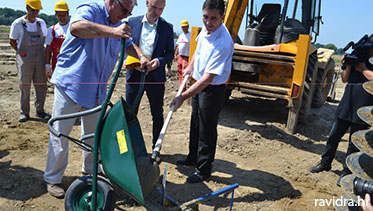
Works on 500 kW canopy photovoltaic system were launched on July 6 in Medinci near the town of Slatina in Croatia’s northeast, Virovitica–Podravina County’s Regional Development Agency said on its website. It is a unique example in the country of combining renewables with agriculture, as the land on which the facility named Sinerot is installed will be used in full for growing vegetables, the report said. The project with 2,128 polycrystalline silicon modules is worth HRK 6.6 million (EUR 870,000), co-funded with EUR 700,000 by the the Environmental Protection and Energy Efficiency Fund, while the county provided the remaining 20%. The design was done by the main contractor, Work-Ing from Varaždin, and also an irrigation water well is planned for the field.
Partners in the endeavour are the Faculty of Agriculture in Osijek, Vidra Development Agency and Slatina’s secondary school ’Marko Marulić’. The agro-energy unit will serve as an educational facility, and the surplus electricity will be utilized by county’s elementary and secondary schools.
Panels will be installed at a height of 2.5 metres, with posts set four metres apart, enabling access to agricultural equipment. All machines will work on electric power, and the solar chargers will be installed on site. County head Tomislav Tolušić announced contracts for more than 200 solar systems for drying tobacco, worth EUR 740,000. Slatina mayor Ivan Roštaš said the town has ten or so projects for renewable energy sources, including two private biogas facilities. The Environmental Protection and Energy Efficiency Fund approved one fifth of national energy rehabilitation funds for public buildings of EUR 11.21 million to Vidra, which is a record, Jutarnji list newspaper said. Also, a EUR 1.32 million worth project for 1.5 MW of solar panel rooftops for 10 schools in the county is about to be implemented, making these institutions net power producers.