





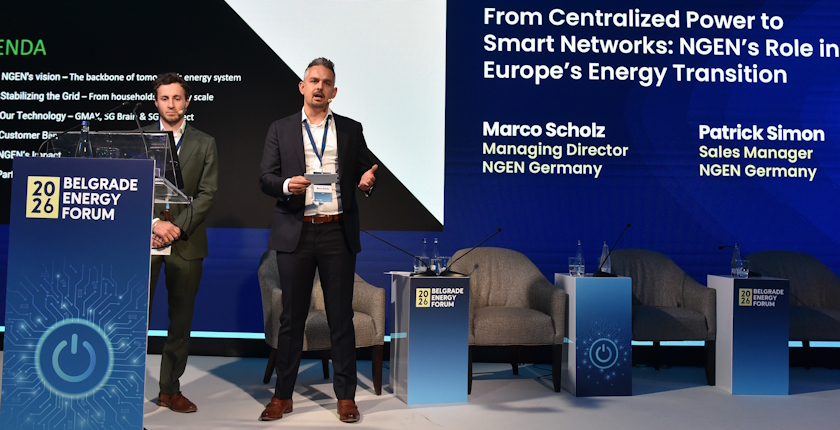
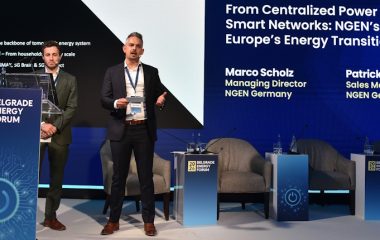
Photo: Patrick Simon (left) and Marco Scholz (Balkan Green Energy News)


At Belgrade Energy Forum – BEF 2026, NGEN Group presented its battery systems and smart solutions that can significantly contribute to Europe’s energy transition. The company envisions the energy system of the future as decentralized, dynamic, and software-controlled, where intelligent management would simultaneously maintain grid stability and create economic value.
Marko Scholz and Patrick Simon from NGEN Group presented its development path and market, which has grown to 11 European countries, at the latest edition of Belgrade Energy Forum in Serbia’s capital city. Founded in 2018 in Žirovnica, Slovenia, the company employs two hundred people. NGEN is currently building approximately 1.25 GWh of battery capacity across the European Union and advancing its SG Brain platform, based on artificial intelligence and designed for energy system management. Balkan Green Energy News held BEF 2026, its flagship annual conference, for the fourth time.
In 2019, the company built its first battery storage facility, with an operating capacity of 12.5 MW and a storage capacity of 22 MWh. In the following years, it developed platforms for battery energy storage systems (BESS), hybrid inverters, smart meters, and electric vehicle charging infrastructure management.
NGEN Group operates and installs battery systems across Central Europe for itself or its partners. Their capacity ranges from a few dozen to over 200 MW each.
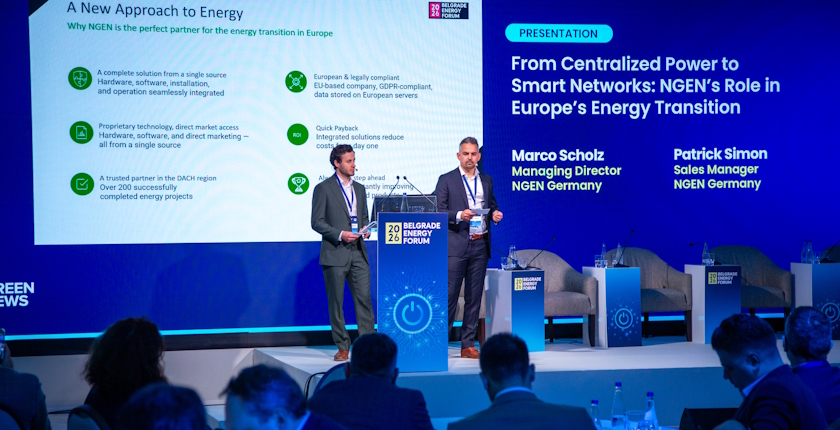
Comprehensive solution from hardware to market access
Managing Director of NGEN Germany Marco Scholz stressed that the energy system of the future would be decentralized, dynamic, and software-controlled, so that Europe needs intelligent management that simultaneously maintains grid stability and creates economic value.
It is where NGEN comes into play.
What sets the company apart from the competition is its holistic approach – it offers a complete energy solution that includes hardware, software, installation, system management, and direct access to the electricity market.
Scholz also highlighted as an advantage that all NGEN’s systems and software comply with the European regulations and General Data Protection Regulation (GDPR) standards.
SG Brain works independently of people
The company’s management believes that the solution is not just in separate technologies, but in connecting the entire sector – from household to utility-scale BESS.
The presentation outlined how its ecosystem is organized, across three levels, designed to operate together as a single intelligent system.
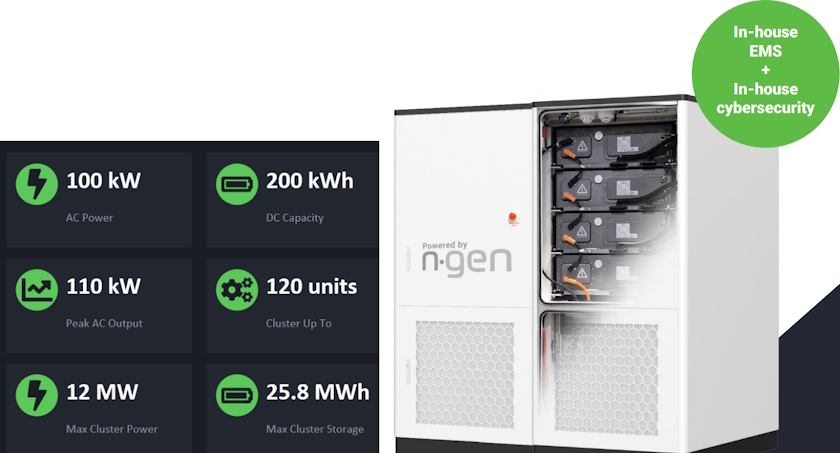
NGEN’s key products are the G-MAX – a battery equipped with proprietary software – and AI platform SG Brain, its integral part.
SG Brain has been added to NGEN’s energy management system SG Connect. It manages energy generation, storage and consumption in real time without the need for human intervention. Sales Manager at NGEN Germany Patrick Simon noted that the system continuously processes data streams: the weather forecast, electricity prices in the market, consumption, and generation from solar and wind power plants. It allows it to automatically make decisions regarding battery charging and discharging, grid application activation and the optimization of renewables.
The entire process takes place completely autonomously, as the software continuously adapts to market conditions on its own.
Infallible system is no longer sci-fi
The ultimate goal is to lower electricity bills, give the highest comfortability and facilitate fully automated operations.
“So imagine a system that never sleeps, that never misses price signals and never makes wrong decisions. That’s not science fiction. It’s working right now, today. It’s the NGEN SG Brain,” Simon said.
NGEN’s representatives warned that electricity market volatility became one of the biggest challenges for companies throughout Europe while decarbonization is no longer a matter of choice but a legal obligation.
In their view, the solution is in combining AI, automated management and direct energy market access. Such systems enable companies to cut electricity costs, better utilize existing infrastructure and gain competitive advantage.


Be the first one to comment on this article.