





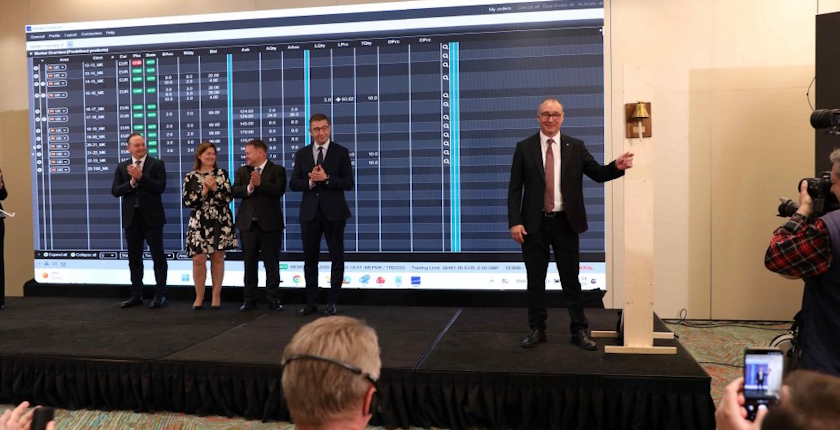
Photo: MEMO


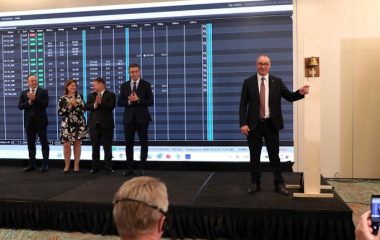
North Macedonia’s National Electricity Market Operator – MEMO marked the launch of its intraday market. High-level representatives from the government, energy sector, institutions and international partners attended the official event. The Slovenian BSP Energy Exchange provided trading platforms and a clearing platform. In addition, electricity bourse SEEPEX in neighboring Serbia allowed negative prices at its day-ahead and intraday markets for today.
The electricity sector of North Macedonia achieved a major upgrade in flexibility and efficiency today. Three years after the establishment of the day-ahead market, National Electricity Market Operator – MEMO launched the intraday market.
It enables electricity trading during the day of delivery, increasing system flexibility, improving efficiency, and significantly reducing the risks of market deviations and imbalance costs, the company pointed out. The Slovenian BSP Energy Exchange provided trading platforms and a clearing platform for both segments, where Deutsche Börse’s M7 is running intraday trade.
Mickoski: North Macedonia must participate in European energy flows, policies
The move demonstrates progress driven by a clear vision and concrete reforms that deliver results, Prime Minister Hristijan Mickoski said at the rollout event.
“At a time when energy is one of the most critical issues for every country, our obligation is to create a system that is secure, competitive, and resilient to global challenges,” he stated. The prime minister recalled that the entire European continent is undergoing an energy transition. North Macedonia mustn’t stand aside – it must be an active participant in European energy flows and policies, said Mickoski.
Minister Sanja Božinovska expressed commitment to the process of market coupling with the European Union
Minister of Energy, Mining and Mineral Resources Sanja Božinovska said the intraday market is not the final destination.
“This is just the starting point for our full integration into the European energy family. In the coming period, we will continue with further steps – developing market mechanisms, deepening regional cooperation, and joining European market coupling processes,” she asserted.
Clear price signal is foundation of efficient system
Chief Executive Officer of MEMO Zoran Gjorgjievski bid welcome to officials and company representatives.
“From today, our market not only plans for tomorrow – it operates in real time. The intraday market is a direct response to the dynamics of the modern energy sector,” he explained.
A clear price signal is the foundation of an efficient system – it enables proper resource allocation, better risk management, and rational investments, especially in renewable energy sources, Gjorgjievski underscored.
“At the same time, we must be aware of the challenges. New European regulatory mechanisms, such as CBAM, while aimed at climate goals, may create additional burdens for domestic producers and affect market liquidity. Therefore, our position is clear: the green transition is necessary, but it must be fair, gradual, and economically sustainable. We must not allow measures intended to accelerate it to instead slow it down,” the head of the bourse’s operator said.
Next is integration into single EU power market
Chairman of the Management Board of ADEX Group and CEO of BSP Energy Exchange Anže Predovnik attributed the introduction of the intraday market to joint efforts, the clear vision of the Government of North Macedonia and dedication of the MEMO team.
“What lies ahead is integration into the single European market. Together, we will build a more connected and competitive future,” he added.
There are already 21 participants in the intraday market.
According to Martin Martinovski, electricity and statistics expert at the Energy Community Secretariat, as market integration with the EU progresses, the intraday market will position North Macedonia as a reliable partner in the regional power system, where each megawatt of low-carbon flexibility can, over time, contribute to balancing neighboring systems – and vice versa.
Trading volumes went from 335 GWh by the end of 2023 and nearly 970 GWh in 2024, to over 1.37 TWh last year, with forty active members. In the first quarter of 2026, volumes were 19% higher than the same period the previous year.
Sanja Božinovska, Anže Predovnik, Zoran Gjorgjievski and Energy Community Secretariat Director Artur Lorkowski are speaking at Belgrade Energy Forum 2026, scheduled for May 11 and 12. Balkan Green Energy News will hold the annual event in Serbia’s capital city for the fourth time.
In other relevant news, Serbian electricity bourse SEEPEX allowed negative prices at the day-ahead and intraday markets, for today, as scheduled.
Be the first one to comment on this article.