






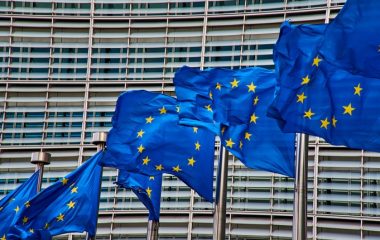
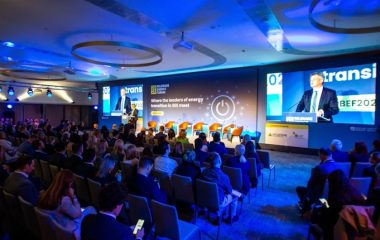
Photo: Dati Bendo / EC - Audiovisual Service


Reducing the share of nuclear energy was a “strategic mistake” that left Europe exposed to volatile fossil fuel imports, according to European Commission President Ursula von der Leyen. The European Union now wants to be part of a global nuclear revival, and the commission has drafted a strategy to accelerate the rollout of small modular reactors to complement traditional nuclear power plants, she said at the Nuclear Energy Summit in Paris.
“This reduction in the share of nuclear was a choice, I believe that it was a strategic mistake for Europe to turn its back on a reliable, affordable source of low-emissions power,” Von der Leyen said in her speech at the summit, organized by the International Atomic Energy Agency (IAEA).
In 1990, one-third of Europe’s electricity came from nuclear energy, but it has decreased to about 15%, Von der Leyen noted.
As Europe is neither an oil nor a gas producer, its fossil fuel consumption is completely dependent on expensive and volatile imports, and the current Middle East crisis is a stark reminder of the vulnerabilities this creates, according to Von der Leyen.
The most efficient energy system, she said, combines nuclear power and renewables, supported by energy storage, flexibility, and grids.
The EU hopes to see small modular reactors deployed by the early 2030s
As part of efforts to revive nuclear energy, the EU changed its state aid rules last year to expand support for nuclear fission and fuels. It also launched the world’s first industrial alliance for small modular reactors (SMRs) and proposed investing over EUR 5 billion in fusion research, according to her.
The most recent move in this direction is the adoption of a European Strategy for Small Modular Reactors, which seeks to ensure the technology is operational in Europe by the early 2030s, so that it can play a key role alongside traditional nuclear reactors, said Von der Leyen.
The European Commission said it would consider an additional EUR 200 million in guarantees until 2028 to support the initial commercial units of innovative nuclear technologies.
Greece is also considering SMRs
Greece is also considering adding nuclear energy to its energy mix. At the summit, Prime Minister Kyriakos Mitsotakis echoed Von der Leyen’s remarks, describing the EU’s shifting away from nuclear energy as a strategic mistake.
He said it was time for Greece to explore whether nuclear energy, and in particular SMRs, could be integrated into the domestic energy system, adding that a committee would be set up to examine the option and make recommendations to the government.
Mitsotakis highlighted Greece’s significant strides in renewable energy, adding that the country would continue to invest in batteries, pumped storage systems, and natural gas as a transitional fuel.
Romania plans to triple its nuclear capacity
Romanian Minister of Energy Bogdan Ivan said the country intends to almost triple its nuclear energy capacity over the next ten years.
Together with renewables, nuclear energy can ensure a stronger, more balanced, and more robust energy system, even in difficult times, Ivan said during the summit.
That is why Romania is working on the modernization and expansion of its Cernavodă nuclear power plant and developing an SMR project in Doicești, according to him.
Serbia hopes to have a nuclear plant online around 2040
Serbian Minister of Mining and Energy Dubravka Đedović Handanović said that Serbia also wants to be part of the nuclear revival as it needs nuclear energy to support the development of its economy, new technologies, and artificial intelligence.
Đedović Handanović said Serbia hopes to complete the first phase of its nuclear program by mid-2027. By 2032, the country should be able to select a technology and initiate the construction process, so that a nuclear power plant can be online around 2040, according to her.
Đedović Handanović recently said the country plans to launch the construction of a nuclear power plant before 2035.
Be the first one to comment on this article.