





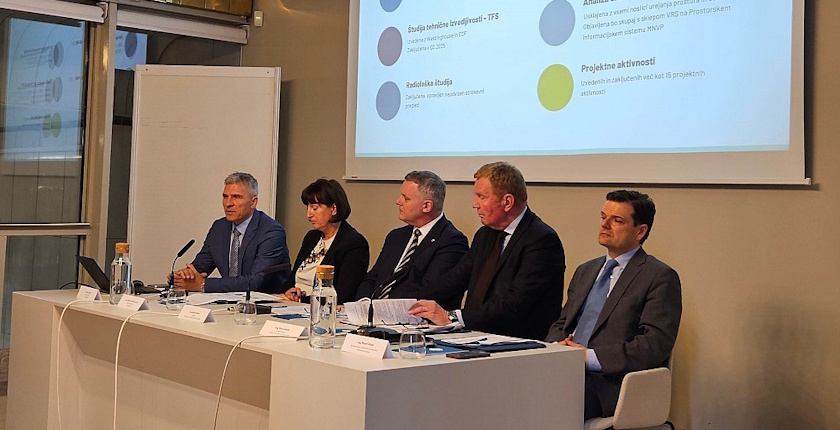
Photo: GEN Energija


Slovenia is capable of financing the construction of the Krško 2 nuclear power plant on its own, according to the latest report of the working group for the preparation of the financing model for the project.
The report was presented to the Government of Slovenia at a meeting where a decision was made to prepare the national spatial plan for the Krško 2 (JEK2) nuclear power plant. The project is being developed by state-owned company GEN Energija.
The plan is scheduled to be presented to the public in the second half of 2027, with adoption expected in the second half of 2028. As part of the plan’s preparation, an environmental impact assessment will be conducted, including a transboundary impact assessment.
Prime Minister Robert Golob said the decision is the kick-off of the process toward concrete solutions and data for the new unit of the Krško nuclear power plant.
Golob: A referendum will be held
He recalled that the planned referendum was canceled because it wasn’t clear enough what the voters would be deciding on. Golob expects the plebiscite to be held in late 2027 or early 2028, when all the necessary information about the project will be prepared.
By then, Slovenia will know the location, the conditions for the construction, the supplier, and the final price, Golob explained.
Regarding the working group’s report on the preparation of the financing model for JEK2, the prime minister pointed out that this is a very important issue because financing costs represent half of the final electricity price.
He didn’t disclose the prices, but said that they are very favorable for the development of the energy-intensive industry in Slovenia.
Drobne Popović: The actual project cost will be known when the contractor is selected and the contract is signed
GEN Energija CEO Nada Drobne Popović stressed that the actual cost of the project will be determined when the contractor is selected and the contract is signed.
The investment is estimated at EUR 9.6 billion for a capacity of 1,000 MW and EUR 15.4 billion for 1,650 MW. When financing costs are included, the value is between EUR 15 billion and EUR 22 billion, Naš stik reported.
The expected production cost of electricity is EUR 60 per MWh to 68 per MWh. The project is expected to be profitable at a sale price of EUR 75 per MWh.
The optimal solution is the establishment of a special purpose vehicle
According to GEN Energija, the key finding of the report from the working group for the financing model is that Slovenia is capable of financing and implementing it on its own. The group has taken into account the country’s economic and fiscal position, access to capital markets, and debt management system.
The optimal organizational solution is the establishment of a special purpose vehicle (SPV), the firm added. This model allows for a clear separation of risks and benefits from other activities of the GEN Group and creates a transparent basis for the involvement of the state and potential investors, according to the company.
GEN Energija’s proposal allows for the inclusion of potential investors
Marjan Divjak, head of the working group and Director General of the Treasury Directorate at the Ministry of Finance, said that the most balanced solution is for the state to lend to the SPV. In addition, there would be a possibility of direct borrowing by the SPV.
The model allows for the simultaneous protection of public financial stability, the phased inclusion of potential investors, and the use of green financial instruments in line with the European Union taxonomy, GEN Energija explained.
In the process of the development of the spatial plan, the company seeks a constructive dialogue with all shareholders and a joint search for optimal solutions, according to CEO Nada Drobne Popović.
The project is historic—complex and demanding, but at the same time an exceptional development opportunity for the region and the country, she stressed.


Be the first one to comment on this article.