







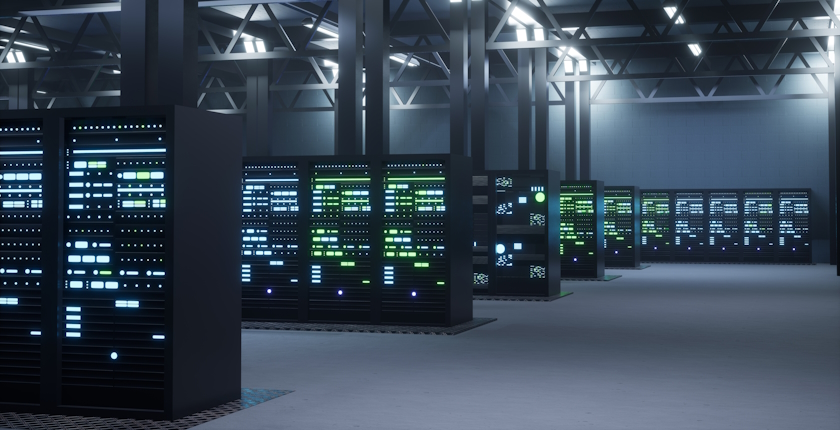
Photo: DC Studio on Freepik


Romania is developing its Black Sea AI Gigafactory project, of up to EUR 5 billion, for artificial intelligence accelerators at the Cernavodă nuclear power plant and the planned small modular reactor facility in Doicești. The computing hub would be powered by 1.5 GW including renewable electricity. At the same time, the country’s largest power distribution company DEER, owned by Electrica, intends to invest in data centers. Transmission system operator Transelectrica wants to install one as well.
Some countries are better off than others in meeting electricity demand from domestic power plants. But planners are looking at a bigger picture and the accelerating changes due to the expected all-out electrification and digitalization. The shift may rapidly reconfigure the landscape. Romania is ambitious to catch the wave both on the power production and consumption side with new technologies including small modular reactors (SMR) and artificial intelligence (AI).
The government submitted a letter of intent last year under the European Union’s call for InvestAI initiative. The project involves setting up 100,000 AI accelerators. The first part of the Black Sea AI Gigafactory supercomputing hub would be at Romania’s sole nuclear power plant Cernavodă.
The Black Sea AI Gigafactory would enable AI services in Romania and throughout the region, including Serbia
In phase two, the chips would be installed in Doicești. It is the site for a project of a small modular reactor (SMR), which could become the first of its kind in the European Union.
Black Sea AI Gigafactory, valued at up to EUR 5 billion, would require 1.5 GW of electricity capacity. The authorities intend to combine nuclear power with renewables. They said the hub would enable AI services in the Black Sea region as well as Serbia.
Private and public entities involved include the biggest Romanian universities. Within the program, the EU and beneficiary member state can cover up to 35% of expenses.
EU-funded AI factory project underway in Bucharest
Separately, the European High-Performance Computing Joint Undertaking (EuroHPC JU) has selected Bucharest three months ago among a total of six sites within its AI Factories call. There are 19 projects involved overall, in 16 EU member states. The latest round is supported with EUR 500 million in public funding.
The aim of the RO AI Factory endeavor is to transform small and medium-sized enterprises (SMEs) from passive technology adopters into active AI innovators by prioritising services, training, and infrastructural access. Scientific and research institutions are leading the project.
It includes acquiring and deploying an AI-optimised supercomputer.
Data centers require high security, safety
The largest electricity distribution company in Romania wants to build data centers. It is considering underground sites, including salt mines and bomb shelters.
Distribuție Energie Electrică România (DEER) is owned by Electrica, in which the government holds just under 50%.
The idea is to make three modular and interoperable data centers: in Cluj-Napoca, Brașov and Ploiești. DEER highlighted the advantages of underground sites for security as well as energy efficiency, suggesting the facilities could use geothermal cooling. Conversely, there are risks of corrosion, connectivity and access issues and hidden costs.
DEER is considering underground sites such as bomb shelters and salt mines
Modernizing the information technology infrastructure is a strategic imperative under the smart grid concept and the management of the massive volumes of data generated by the four million users and new prosumers, the firm said, as reported by Profit.ro.
TSO Transelectrica has its own project for the optimization of its communications network and the establishment of a data center. It would need to remain operational in extreme cases such as war, earthquake, floods and cyberattacks.
Public Power Corp. (PPC Group) in Greece is also developing major data center projects. It would use sites within its coal power complex, which is due to end all operations this year.


Be the first one to comment on this article.