







Photo: iStock


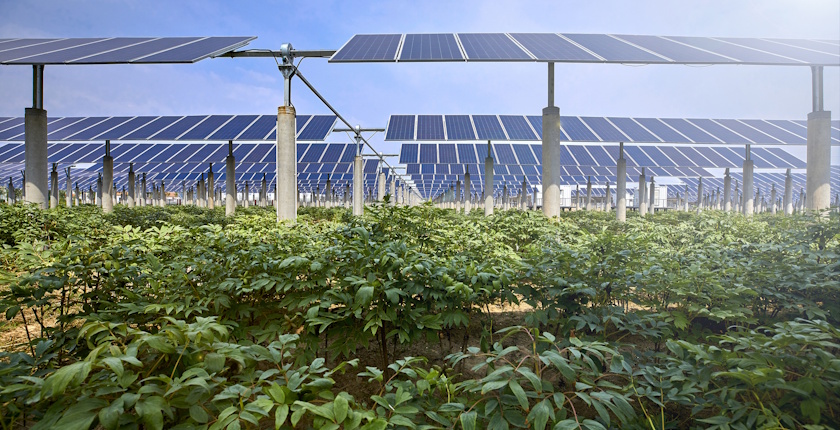
A research and demonstration project titled ‘Increasing the resilience of the food supply chain to the complex challenges of the modern world’ has been launched in Romania. The aim is to develop an agrisolar (AgriPV) system with batteries, designed to provide electricity for irrigation in agriculture.
The project is led by the National Institute for Research and Development of Isotopic and Molecular Technologies (INCDTIM) and is implemented in cooperation with the Agro-Food-IND Napoca Cluster, as well as other industry partners. One of them is Agramia, whose farm will host real-life testing of the system.
According to participants, the initiative aims to develop integrated and multidisciplinary solutions based on innovative scientific and technical concepts, with the goal of increasing the resilience of the food supply chain to current challenges and improving the use of Romania’s agricultural potential.
The endeavor is worth RON 52.5 million (EUR 10.3 million), of which RON 47.7 million (EUR 9.4 million) is a grant from the European Regional Development Fund, under the Smart Growth, Digitalization and Financial Instruments Programme 2021-2027. The three-year project runs until November 2, 2028.
Solar panels to supply energy for irrigation
Representatives of Prodfer Construct, owned by engineering, procurement, and construction (EPC) services provider Parapet, said photovoltaic panels and energy storage would supply electricity for irrigation. The system will be tested on plots where cereal crops, vegetables, or medicinal plants are grown. Parapet builds photovoltaics and batteries.
The prototype demonstration aims to assess agrisolar’s technical, economic, and environmental performance as well as its impact on agricultural productivity and water resource management.
Throughout the agricultural season, key indicators will be monitored, including water consumption, electricity generation, crop development, and the reduction in water evaporation that shading from the photovoltaic panels would cause.
An analysis will be carried out to evaluate both the quantitative and qualitative impacts of the system on agricultural production, as well as its contribution to food security through reduced water and energy losses and increased resilience to extreme climate events.
Based on the results, the project partners will consider potential adjustments to optimize system performance and assess opportunities for wider deployment at local and national levels.
In addition, the project includes the development of a software application aimed at optimizing energy consumption on farms.


Be the first one to comment on this article.