







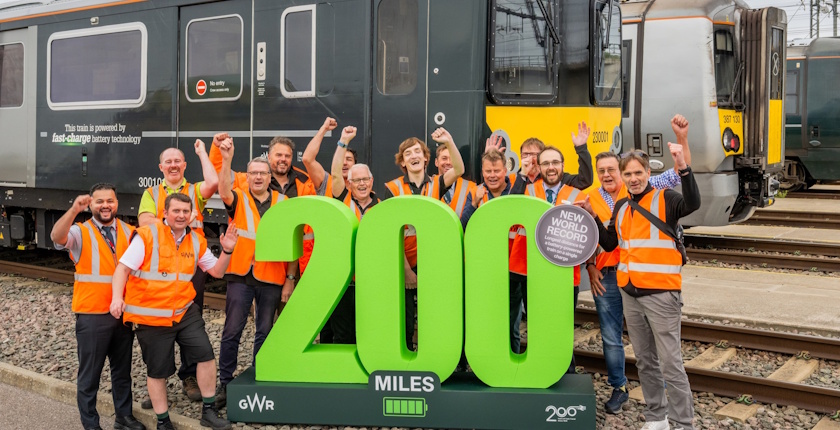
Photo: Great Western Railway


British rail operator Great Western Railway (GWR) has set a new world record for the longest distance traveled by a battery-powered train. A Class 230 train covered 320 kilometers without recharging, marking a significant step forward in the development of sustainable rail technology.
The record-breaking journey took place on August 20, coinciding with the 200th anniversary of the modern railway in the UK. The achievement was made by a specially adapted former London Underground train from 1982, part of the Class 230 fleet. The train completed a 322-kilometer round trip from Reading, via London Paddington and Oxford, and back to Reading.
The train operated in the so-called “super mode,” maintaining speeds between 48 and 64 km/h, with the heating system turned off. According to GWR’s estimates, under optimal conditions and at a maximum speed of 96 km/h, the range would be about 192 kilometers.
The previous record was 223.7 kilometers
The previous record was set in 2021 in Berlin by German rail company Stadler Deutschland, whose train managed 223.7 kilometers on a single battery charge.
The Rail Performance Society has officially verified the new record.
“We can confirm that, subject to final checks, the Great Western Railway Class 230 train travelled 200 miles on a return journey from Reading Train Care Depot without charging its batteries from any external energy source,” said Nigel Smedley, Deputy Chair of the Rail Performance Society.
GWR is looking into replacing diesel trains with battery-powered units
GWR reported that the train used six batteries, with five active throughout the journey. At the end of the trip, the batteries still had 22% capacity remaining, which would have been enough to cover an additional 93 kilometers.
The company is currently exploring the possibility of introducing battery-powered trains to replace existing diesel multiple units, which are expected to be phased out within the next seven to ten years. Tests have shown that battery-powered trains produce up to 80% lower emissions compared to their diesel counterparts.
Last year, GWR tested a fast-charging train, when a Class 230 unit traveled 138 kilometers using battery power alone, consuming only 45% of the battery capacity. That trial hinted at the potential for much longer ranges, which has now been confirmed with the record-breaking 320-kilometer journey.



Be the first one to comment on this article.