





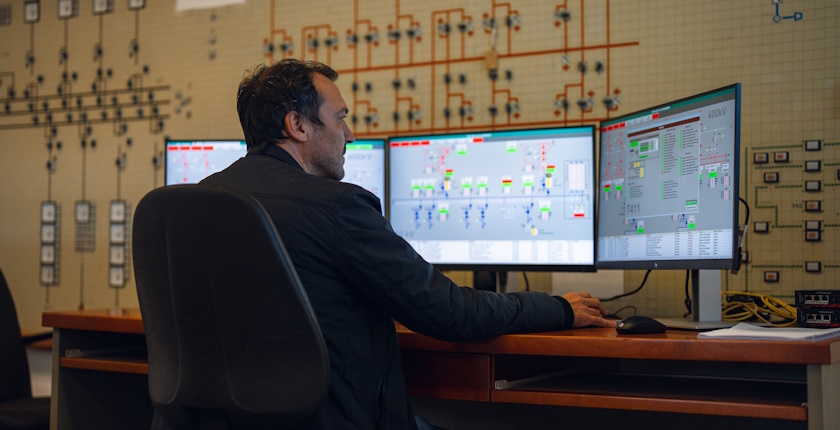
Photo: ELES


Slovenia has started the development of a robust cybersecurity framework based on an AI system for the electricity sector.
The project ALiEnS-SOC (Artificial Intelligence for Slovenian Electro-Energy Sector Security Operation Centre) is being implemented by 13 companies and institutions while Slovenia’s transmission system operator ELES is the coordinator.
Other project partners are the country’s five distribution system operators – Elektro Celje, Elektro Gorenjska, Elektro Ljubljana, Elektro Maribor and Elektro Primorska, together with the Academic and Research Network of Slovenia (ARNES), Government Information Security Office, Telekom Slovenije, Informatika, Smartis, Tiko Pro and Croatian firm Končar – Digital.
Funded under the Digital Europe program, ALiEnS-SOC aims to pioneer a robust cybersecurity framework featuring an AI-based system with full replicability potential, piloted and validated within a national SOC for electricity.
ELES: Security of critical energy infrastructure has become a top priority
Of note, worldwide cyberattacks in the energy sector have doubled from 2020 to 2022. Companies in the region, including Slovenia, Serbia, and Montenegro, were also targeted. The latest analysis indicates that energy companies are taking the threat very seriously.
ELES said the energy sector is at the heart of modern society, with an uninterrupted electricity supply being crucial for daily life. However, as cyber threats grow more sophisticated, ensuring the security of critical energy infrastructure has become a top priority.
ALiEnS-SOC aims to tackle these challenges by developing an advanced, AI-driven cybersecurity system tailored for security operation centers (SOCs), according to the TSO.
It added the project would introduce state-of-the-art AI technologies, cyber threat intelligence (CTI) sharing, and real-time response mechanisms to mitigate risks and ensure the resilience of the energy sector.
Government of Slovenia: Strengthening cybersecurity at the national and EU level
The Government of Slovenia expects the endeavor to improve detection, interception, and response to security incidents and vulnerabilities, but also to reduce risk and increase the speed of response.
The project is tackling the operational and technical challenges faced by cybersecurity experts in the power sector, according to Tiko Pro.
The total value is EUR 9.92 million of which the European Union provided EUR 4.96 million. The project, which started in January, is scheduled for completion in December 2027.



Be the first one to comment on this article.