





Photo: Ministry of Energy / Facebook


Bulgaria has grand plans for energy storage, with massive subsidies for batteries plans for two pumped storage hydropower plans, but it also needs to put the Chaira pumped storage facility back together. One of four units is finally back on the grid following long delays.
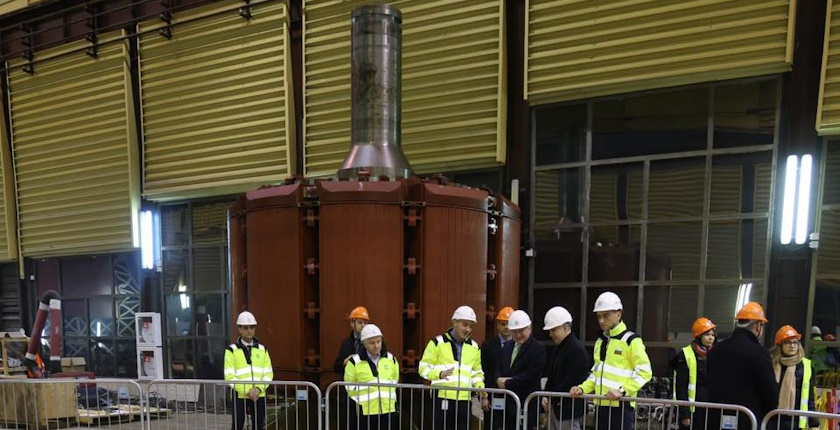
After more than two and a half years, the Chaira pumped storage power plant is in operation again, though only partly. State-owned National Electricity Co. (NEK) managed to repair unit 2. The move was so significant that caretaker Prime Minister Dimitar Glavchev arrived to inspect the facility himself.
The largest system of its kind in Southeastern Europe has been down completely since May 2022 due to massive outages. The restoration process involved a globally unique modification in the stator to distribute stress more evenly, officials said.
They are planning the same approach for unit 3, which is already being dismantled. It is the first reconstruction of the Chaira pumped storage hydroelectric facility. Units 1 and 2 were completed in 1995 and the remaining ones in 1999.
Unit 3 to be commissioned by end-2025
German contractor Voith handled the repair. Unit 2 has 205 MW in generation mode while pumping consumes up to 197 MW. The Ministry of Energy estimates that the restoration of unit 3 would last until late next year. Minister Vladimir Malinov revealed he expects the signing of an agreement with Toshiba, the manufacturer of the first two units, before the end of the year.
The Chaira pumped storage system was the biggest in Southeastern Europe, with 784 MW in pumping mode and 864 MW for generating electricity. Under a current public procurement for the first and fourth units, EUR 124 million is in the budget.
NEK hoping for grants to complete Chaira restoration
NEK is getting a portion of the funding through the Kozloduy International Decommissioning Support Fund.
The utility, part of Bulgarian Energy Holding or BEH, also aspires to obtain grants. In addition, NEK is developing projects for two pumped storage hydropower plants, while already it operates two others except Chaira.
Notably, the Ministry of Energy earmarked massive grants, for different types of battery energy storage systems (BESS). It is another strategic move aimed at accommodating new renewables. However, Bulgaria has troubles with European Union funding due to an almost continuous political crisis that began three and a half years ago.
Be the first one to comment on this article.